Showing posts with label Edward Arlington Robinson. Show all posts

Saturday, September 10, 2016

How to Be an American Writer, Part 8: Satirists and Critics

The last approach to being an American writer that I’d like to discuss is the satirist or the critic. These writers do engage directly with the American mainstream, unlike the expatriate or the internal exile, for instance. But the critics and satirists paint the United States in order to hold up a mirror and show the blemishes, often to hilarious effect.

I’d say the best known U.S. writer satirist/critic is Mark Twain, who had an uncanny ability to mimic the speech and the foibles of the common man or woman.

One of my favorite parts of Twain’s The Adventures of Huckleberry Finn is his portrayal of Tom Sawyer’s gullible Aunt Sally. Aunt Sally is trying to figure out how the leg of the bed in Jim’s prison was sawed off, when Jim was locked in a room with no saw. In reality, Tom Sawyer did the sawing—is that a pun? Here is Aunt Sally’s description of the situation:

“You may well say it, Brer Hightower!  It’s jist as I was a-sayin’ to Brer Phelps, his own self.  S’e, what do you think of it, Sister Hotchkiss, s’e? Think o’ what, Brer Phelps, s’I?  Think o’ that bed-leg sawed off that a way, s’e?  think of it, s’I?  I lay it never sawed itself off, s’I—somebody sawed it, s’I; that’s my opinion, take it or leave it, it mayn’t be no ’count, s’I, but sich as ’t is, it’s my opinion, s’I, ‘n’ if any body k’n start a better one, s’I, let him do it, s’I, that’s all.”

What a gift for rendering the Mississippi Valley dialect Twain had! As much as Twain makes fun of the common man and woman, though, and the gullibility of Americans, you do get the sense that he is in some ways a populist. His poking fun is often done out of a democratic impulse to nudge the masses toward greater awareness, and not out of a deeper cynicism about the U.S.

Other notable American satirists or critics:

On the poetry side, Edward Arlington Robinson, author of “Miniver Cheevy.” Robinson had a knack for finding the underside of different fates. 

e.e.cummings, particularly in poems such as “pity this busy monster, manunkind,” showed the materialistic and insensitive face of U.S. society. 

On the fiction side, Sinclair Lewis, a novelist whose work was extremely important for my parents’ generation. Lewis, one of the few Americans to win the Nobel Prize for Literature, is not read as much today as he was two generations ago, but he produced some scathing satires of small-town American life, including the novels Babbitt and Main Street. His dystopian fiction about fascism taking over an all-American community, It Can’t Happen Here, published in 1935, might well be a prophetic glimpse at the regional surge of extreme right politics outside of urban America.

Sinclair Lewis, author of It Can't Happen Here and other novels
NathanaelWest, author of Miss Lonelyhearts, mocked the shallowness of popular American culture.

I think some of the recent American women novelists are critics of American society, such as Jane Smiley, author of A Thousand Acres, and the excellent novellas, Ordinary Love & Good Will, which both shine a flashlight on tender spots in American culture. 

There’s also Jane Hamilton, who wrote the novel A Map of the World, a scathing critique of the prejudices and limitations of Middle America—in the world of that novel, if you make one false move, you become an anathema.

Ishmael Reed is a wonderful satirist who critiques American society with African American funk in mind in such novels as Mumbo Jumbo. Reed is also a poet, essayist, and playwright, one of the few writers who excels in all those genres.
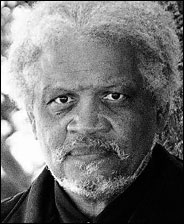

Ishmael Reed, author of Mumbo Jumbo and many other books
We could add to the satirists John Kennedy Toole, who wrote A Confederacy of Dunces (a book I’ve never been able to finish, I have to admit).

In the nonfiction category, there’s Tom Wolfe, who pokes fun at the American intelligentsia and other aspects of U.S. life in such books as Radical Chic & Mau-Mauing the Flak Catchers and The Painted Word.

The satirist or critic challenges the American mainstream. Unlike the populist writer, he or she doesn’t see the U.S. experience as a source of wisdom or epiphanies about the meaningful, small moments of everyday life. Critics and satirists are taking aim at American society, often with either a humorous or reformist intent, but highlighting the sides of U.S. culture that are deserving of scrutiny or even mockery.


Friday, April 4, 2014

Homage to Louis Untermeyer

Louis Untermeyer (1885–1977) edited the very first poetry book I ever owned. I think it was called The Golden Treasury of Poetry, and it had a gold paperback cover. There were lots of poems in it I liked when I was a kid. I remember Oliver Wendell Holmes’s ballad “The Deacon’s Masterpiece or the Wonderful One-Hoss-Shay.” In addition to that anthology, Louis Untermeyer wrote or edited more than 100 books. I always thought of him as a compiler of anthologies, and as a figure in American culture, a sort of intellectual about town.

Louis Untermeyer
Recently I encountered some poems by Untermeyer in an anthology of poetry on audiobook, The Spoken Arts Treasury, Volume 1. It’s a collection full of the U.S. poets who were very popular in the 1950s, writers we hardly ever read or hear today, such as Mark Van Doren, Allen Tate, and Conrad Aiken. The collection includes several diamonds, among them the poems written and read by Louis Untermeyer.

When I heard Untermeyer on this CD, I felt that he was also a force as a poet. His poems seemed on the surface to be written in a fairly predictable meter and rhyme scheme, but despite that, they never ceased to surprise me. Every time I thought I could guess what was coming, Untermeyer came up with an image or an idea that was completely unexpected—and true.

Here’s one of the poems that grabbed me, a sort of atheist prayer:

Caliban in the Coal Mines

God, we don’t like to complain—
  We know that the mine is no lark—
But—there’s the pools from the rain;
  But—there’s the cold and the dark.

God, You don’t know what it is—        
  You, in Your well-lighted sky,
Watching the meteors whizz;
  Warm, with the sun always by.

God, if You had but the moon
  Stuck in Your cap for a lamp,        
Even You’d tire of it soon,
  Down in the dark and the damp.

Nothing but blackness above,
  And nothing that moves but the cars—
God, if You wish for our love,        
  Fling us a handful of stars!

Untermeyer was known as a champion of the underdog, and this poem showcases that side. He speaks in the voice of the despised Caliban of Shakespeare’s The Tempest, more than half a century before that revisionist view of Caliban became popular. But Untermeyer’s Caliban is a miner, and one who can speak his mind, even to God. I love the image of the miner’s headlamp as a moon. And that final image with the verb “fling”— so powerful, so vivid.

Untermeyer got into quite a lot of trouble for his outspoken radicalism. In the early days of TV, he made his living and much of his reputation for several years as a quiz show panelist on the program “What’s My Line?” This show involved television personalities guessing the occupation of surprise guests. Here’s a link to a YouTube of one of the shows, with Untermeyer as a panelist.

Untermeyer lived in New York City, where the program originated. Imagine what his life was like, recognized by the guy who served him his slice of pizza and the newsboy who sold him the afternoon paper—and their commenting on his good or bad guesses on last night’s show—the life of a celebrity.

When Joseph McCarthy’s witchhunt of radicals gripped the U.S.A. in the 1950s, Untermeyer was blacklisted, and overnight, he was fired from “What’s My Line?” with no warning. Imagine the shock, and the blow to him—he couldn’t go anywhere without everyone asking why he was no longer on the program. As a result, Untermeyer didn’t leave his apartment or answer the phone for a year and a half. More on what happened to him in a moment.

Here is another prayer that Untermeyer wrote, but in a voice that sounds very much his own. There is also a wonderful YouTube audio of Untermeyer reading this poem with a plainspoken and sincere delivery. The poem is titled simply “Prayer.” 

God, though this life is but a wraith,
    Although we know not what we use,
Although we grope with little faith,
    Give me the heart to fight — and lose.

Ever insurgent let me be,
    Make me more daring than devout;
From sleek contentment keep me free,
    And fill me with a buoyant doubt.

Open my eyes to visions girt
    With beauty, and with wonder lit —
But always let me see the dirt,
    And all that spawn and die in it.

Open my ears to music; let
    Me thrill with Spring’s first flutes and drums —
But never let me dare forget
    The bitter ballads of the slums.

From compromise and things half done,
    Keep me with stern and stubborn pride;
And when at last the fight is won,
    God, keep me still unsatisfied.

O.K., there are lines I could lose here, like “Open my ears to music…” Pretty corny. But what an amazing idea about what to pray for: “Give me the heart to fight—and lose.” I like the concept of being filled with “buoyant doubt.” And how about that fabulous last line?

So, Untermeyer had the political side of his poetry in order, even though he paid a terrible price for his commitment. In fact, he persisted long enough to outlive his enemies. When President John F. Kennedy took office in 1961, Untermeyer was appointed the Consultant in English Poetry for the Library of Congress, a position that was then the equivalent of U.S. Poet Laureate.

Untermeyer’s career came full circle from a political standpoint. But he was not only a political poet from an economic perspective. Consider this poem, a fascinating take on the battle of the sexes, especially coming from a man:

The Wise Woman

His eyes grow hot, his words grow wild;
He swears to break the mold and leave her.
She smiles at him as at a child
That’s touched with fever.

She smoothes his ruffled wings, she leans
To comfort, pamper and restore him;
And when he sulks or scowls, she preens
        His feathers for him.

He hungers after stale regrets.
        Nourished by what she offers gaily;
And all he thinks he never gets
She feeds him daily.

He lusts for freedom; cries how long
        Must he be bound by what controlled him!
Yet he is glad the chains are strong.
And that they hold him.

She knows he feels all this, but she
        Is far too wise to let him know it;
He needs to nurse the agony
That suits a poet.

He laughs to see her shape his life.
        As she half-coaxes, halt-commands him;
And groans it’s hard to have a wife
Who understands him.

That odd pattern of syllables in each stanza—lines of 8, 9, 8, and then a shorter line of 5 beats—it felt familiar. Why? It's exactly the same unusual metric that Edward Arlington Robinson created for his famous poem, “Miniver Cheevy.” Like “Miniver Cheevy,” Untermeyer’s “The Wise Woman” is a deeply ironic portrait of a man (Untermeyer’s title notwithstanding). That last five-syllable line in each stanza functions almost like a punch line, undermining the more traditional and heroic gait of the first three, longer lines in the stanza.

Untermeyer describes the husband in this poem in the third person, but I can’t imagine this is anyone but the author. He even identifies the husband as a poet. Maybe the third person allowed him that ironic distance and a chance to see himself from his wife’s standpoint. The speaker fantasizes a more promiscuous life, all the while comfortable within his marriage, even when he does and doesn’t realize it. “The Wise Woman” is an interesting take on how men and women dance together in a long-term relationship, giving much of the credit to the woman for her wisdom, understanding, and warmth.


Untermeyer came from a Jewish-American family, and his spirit feels very Jewish to me. That combination of warmth, sardonic humor, and compassion for the oppressed is as Jewish as a bagel and schmear. Not that Jews have a monopoly on any of those traits—or on bagels and schmears, at this point in history.


Korean bagels
Other recent posts about writing topics: 
How to Get Published
Getting the Most from Your Writing Workshop
How Not to Become a Literary Dropout
Putting Together a Book Manuscript
Working with a Writing Mentor
How to Deliver Your Message
Does the Muse Have a Cell Phone?
Why Write Poetry? 
Poetic Forms: IntroductionThe SonnetThe SestinaThe GhazalThe Tanka
How to Be an American Writer