The
last approach to being an American writer that I’d like to discuss is the
satirist or the critic. These writers do engage
directly with the American mainstream, unlike the expatriate or the internal
exile, for instance. But the critics and satirists paint the United States in
order to hold up a mirror and show the blemishes, often to hilarious effect.
I’d
say the best known U.S. writer satirist/critic is Mark Twain, who had an
uncanny ability to mimic the speech and the foibles of the common man or woman.
One
of my favorite parts of Twain’s The
Adventures of Huckleberry Finn is his portrayal of Tom Sawyer’s gullible
Aunt Sally. Aunt Sally is trying to figure out how the leg of the bed in Jim’s
prison was sawed off, when Jim was locked in a room with no saw. In reality,
Tom Sawyer did the sawing—is that a pun? Here is Aunt Sally’s description of
the situation:
“You may well say it, Brer Hightower! It’s jist as I was a-sayin’ to Brer
Phelps, his own self. S’e, what do
you think of it, Sister Hotchkiss, s’e? Think o’ what, Brer Phelps, s’I? Think o’ that bed-leg sawed off that a
way, s’e? think of it, s’I? I lay it never sawed itself off,
s’I—somebody sawed it, s’I; that’s my opinion, take it or leave it, it mayn’t
be no ’count, s’I, but sich as ’t is, it’s my opinion, s’I, ‘n’ if any body k’n
start a better one, s’I, let him do it, s’I, that’s all.”
What
a gift for rendering the Mississippi Valley dialect Twain had! As much as Twain makes fun of the common
man and woman, though, and the gullibility of Americans, you do get the sense that
he is in some ways a populist. His poking fun is often done out of a democratic
impulse to nudge the masses toward greater awareness, and not out of a deeper
cynicism about the U.S.
Other notable American satirists or critics:
On
the poetry side, Edward Arlington Robinson, author of “Miniver Cheevy.” Robinson had a knack for finding the underside of different fates.
e.e.cummings, particularly in poems such as “pity this busy monster, manunkind,” showed the materialistic and insensitive face of U.S. society.
On
the fiction side, Sinclair Lewis, a novelist whose work was extremely important
for my parents’ generation. Lewis, one of the few Americans to win the Nobel
Prize for Literature, is not read as much today as he was two generations ago,
but he produced some scathing satires of small-town American life, including
the novels Babbitt and Main Street. His dystopian fiction about
fascism taking over an all-American community, It Can’t Happen Here, published in 1935, might well be a prophetic
glimpse at the regional surge of extreme right politics outside of urban
America.
 |
| Sinclair Lewis, author of It Can't Happen Here and other novels |
NathanaelWest, author of Miss Lonelyhearts, mocked the shallowness of popular American culture.
I
think some of the recent American women novelists are critics of American
society, such as Jane Smiley, author of A
Thousand Acres, and the excellent novellas, Ordinary
Love & Good Will, which both shine a flashlight on tender spots in
American culture.
There’s also Jane Hamilton, who wrote the novel A Map of the World, a scathing critique
of the prejudices and limitations of Middle America—in the world of that novel,
if you make one false move, you become an anathema.
Ishmael Reed is a wonderful satirist who critiques American society with African American funk in mind in such novels as Mumbo Jumbo. Reed is also a poet, essayist, and playwright, one of the few writers who excels in all those genres.
Ishmael Reed is a wonderful satirist who critiques American society with African American funk in mind in such novels as Mumbo Jumbo. Reed is also a poet, essayist, and playwright, one of the few writers who excels in all those genres.
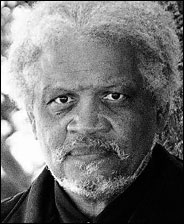 |
| Ishmael Reed, author of Mumbo Jumbo and many other books |
We
could add to the satirists John Kennedy Toole, who wrote A Confederacy of Dunces (a book I’ve never been able to finish, I
have to admit).
In
the nonfiction category, there’s Tom Wolfe, who pokes fun at the American
intelligentsia and other aspects of U.S. life in such books as Radical Chic & Mau-Mauing the Flak
Catchers and The Painted Word.
The
satirist or critic challenges the American mainstream. Unlike the populist
writer, he or she doesn’t see the U.S. experience as a source of wisdom or
epiphanies about the meaningful, small moments of everyday life. Critics and
satirists are taking aim at American society, often with either a humorous or reformist intent, but highlighting the sides of U.S. culture that are deserving
of scrutiny or even mockery.
Zack’s most recent book of poems, Irreverent Litanies
Zack’s most recent translation, Bérénice 1934–44: An Actress in Occupied Paris by Isabelle Stibbe
Other recent posts about writing topics:
How to Get Published
Getting the Most from Your Writing Workshop
How Not to Become a Literary Dropout
Putting Together a Book Manuscript
Working with a Writing Mentor
How to Deliver Your Message
Does the Muse Have a Cell Phone?
Why Write Poetry?
Poetic Forms: Introduction; The Sonnet, The Sestina, The Ghazal, The Tanka, The Villanelle
Praise and Lament
How to Be an American Writer
Writers and Collaboration
Types of Closure in Poetry

