Showing posts with label Ezra Pound. Show all posts

Monday, March 10, 2025

Interview with Poet Joan Larkin about Her Book Old Stranger

Joan Larkin’s sixth book of poems is Old Stranger (Alice James Books 2024). Her previous work includes My Body: New and Selected Poems, winner of the Publishing Triangle's Audre Lorde Award, and Blue Hanuman (Hanging Loose Press). A lifelong teacher, Joan has served on the faculties of Sarah Lawrence College, Smith College, and Brooklyn College, among others. Her honors include Lambda and NEA awards and the Shelley Memorial Award from the Poetry Society of America.

Joan Larkin, poet and author of Old Stranger
Zack Rogow: Many of the poems in your collection Old Stranger are very particular to your own life and memories, and yet they resonate deeply for me. How do you present highly personal experiences so they reach the hearts of readers with different backgrounds and stories from your own? 

Joan Larkin: I’m almost never thinking about a possible reader when I write. Instead, I’m focused on trying to find words for some experience or feeling that won’t let go of me. But thinking about who might be listening does come into the revision process. The reader matters––I don’t want to be obscure,  nor do I want to explain what the images convey. To make a world the reader can enter, I work to describe what I’m seeing with an exactness and vividness that satisfies me as fresh and true, and to make a kind of “mouth music” that gives me a kind of primal pleasure. I feel surprised and lucky when a reader responds with recognition. 


You seem to resist making conclusions or tying up loose ends in these poems. Why is it some of the poems come across more as questions than as answers, and who are the questions being asked of?


Though I love to end a  poem on a strong image and want it to be a memorable one, my choice not to tie up loose ends or to provide an answer is deliberate. Sometimes I go through several drafts before seeing that I can cut a final line or lines that state something I’ve already physicalized in the poem. The poem can’t be an essay. I want to make a world that goes on spinning.


The language in Old Stranger is precise and crisp, with no wasted verbiage. You also create startling combinations of words, such as “red milk,” or “well of onions her bread signature.” Do you think the texture of your writing has changed in this book, and if so, what was the progression for you to the style in this new collection?


I do think that the texture of my writing has changed in this book. Less chatting. More elliptical leaps. I’m less concerned with whether a line makes sense (though I do want to make sense!) than that it be alive. Ezra Pound’s “Deliver it alive” is still the test.


I didn’t get there alone. One example of what changed over more than a decade of conversation with a few trusted poets: I’d written a long poem about 17th century Baroque painter Artemesia Gentileschi, line after line filled with details from my research into her life. After a long silence, my friend Jean Valentine pointed to six lines that focused on a single painting and said, “This is the heart of the poem.” Dubious, I asked, “But is it enough?” Her reply, “It is, for me,” changed the way I saw what mattered most in the poem and in many others over the years since.


A number of the poems in Old Stranger are ekphrastic, meaning they’re inspired by a particular work of art. Those include six short poems on paintings by the German artist Paula Modersohn Becker, the woman Rainer Maria Rilke addressed so personally in his major poem “Requiem for a Friend.” What is it about a particular work of art that provokes a poem for you?


Music and visual art––made things––have engaged and sustained me from early on. My two brief long-ago marriages were to painters, and I’ve fallen in blind love with singers and other artists, my attachment in part the result of mistaking the maker for the making-ness. Turpentine fumes and the squeak of a bow still attract me like nothing else. I’m drawn to what can I learn from the artist’s process and skill, vision and commitment, and what it can touch in me.


The Paula Modersohn-Becker self-portrait I chose for the cover of Old Stranger looked to me as if her face were a whitish mask she was holding up, both covering and revealing the face underneath––suggesting the play between her art and interior life. I saw the beaded necklace as the sole marker of femaleness. The expression of mouth, eyes, and hand spoke of a vivid consciousness I wanted to know more about. Modersohn-Becker painted it in the first decade of the 20th century, long before I attended literature classes in which work by women poets was absent. The college library’s sole book about Emily Dickinson was part of the American Men of Letters series. But Modersohn-Becker, like Dickinson, knew what she was: “wood, with a gift for burning” (Adrienne Rich’s self-image in her 1970s poem “Song”). Modersohn-Becker produced strong, original work before her early death from childbirth. Her cut-short artist’s life, as well as what I saw in a revelatory gallery exhibit, drew me to make ekphrastic work based on her paintings.  Similarly, Camille Claudel’s tragic career and Bonnard’s wife’s role as his barely visible model inspired poems of loss and erasure.


Some of the poems in Old Stranger strike me as being almost a new genre, poems such as “My Father’s Tie Rack.” Those poems capture a moment of precise observation that takes place at a specific time, but one that echoes down a tunnel of memories into the past. How did you come upon that form, and do you have a way of referring to it or a name for it?


I think of “My Father’s Tie Rack” simply as a list poem. But in the process of revising it, I also thought, What if this could be a kind of loose sonnet? Limiting a poem to fourteen lines or imposing some other rule (for example a certain number of strong stresses to the line) helps me work the language to make it more concise and alive. There’s power in limiting one’s options.


 I often don’t know what shape a poem is going to take until some sound pattern begins to recur and a form suggests itself. But with “My Father’s Tie Rack,” I had a clear idea beforehand that I wanted to write a list poem, in this case a list of images and metaphors to evoke neckties I remembered––something extravagant and unusual about them had struck my young eyes, each tie a piece of art. I didn’t know consciously at the beginning that I wanted to convey my father’s complex, rich personality. And I had no idea that I’d end up intuitively swerving toward an image of his death (“the hole”) and the hint of power or even violence contained in the final word, “belts.” In hindsight, I see that the poem is both a portrait and an encounter.


The way this poem took shape is true of others, too, where my unconscious mind was making choices. I love your discerning that a particular observation “echoes down a tunnel of memories into the past,” but in the moment of writing, I typically don’t understand or consciously control the process. The U-turns a draft wants to take often surprise me.


In many poems you describe a vivid incident from your earlier years, such as “All at Once.” Are there particular types of experiences that sparked those poems?


I’m still thinking about familial and societal expectations of girls and women, of shame and trauma held under pressure at a depth. But though difficult past experiences still ignite poems, my old ways of seeing and representing them have changed as I’ve loosened my hold on my old story lines. “All at Once” was sparked by a memory of what people used to call a shotgun wedding (do we still say that?), followed by a miscarriage in a car on a cross-country journey. What I wanted to do in that poem was to look back without attachment and evoke the physical sensations of that awful moment in the car. I wanted to find language for the life of the body––the house of pleasure and trauma, wounding and healing.

_________________________________
Zack’s new book of poetry, The Kama Sutra for Senior Citizens and Other Poems on Aging. Order in the USA    Order in the UK
Other posts of interest:

How to Get Published

Getting the Most from Your Writing Workshop

How Not to Become a Literary Dropout

Putting Together a Book Manuscript

Working with a Writing Mentor

How to Deliver Your Message

Does the Muse Have a Cell Phone?

Why Write Poetry?

Poetic FormsIntroductionthe Sonnetthe Sestinathe Ghazalthe Tankathe Villanelle

Praise and Lament

How to Be an American Writer

Writers and Collaboration

Types of Closure in Poetry


Friday, July 10, 2020

Does a Poem Have to Stand on Its Own?

An intriguing question came up in my poetry writing group the other day. One of the poets brought in a poem that had exciting language, and seemed to be about a fascinating topic. But no one in the group could quite figure out the general subject of the poem. Once the poet clued us in about the theme of the poem, all the pieces fell beautifully into place, and we could see how strong a poem it was.

The writer said that the poem made sense in the context of a collection in progress, where several of the poems that come before this one are about the same topic. The poet asked, “Should a poem be able to stand on its own?”

Great question! Thinking about it, I realize that we usually encounter poems differently now than we did before the Internet became the dominant source of information. In a collection of poems by the same writer, there are many opportunities for a poem to rely on the works around it for context and support of its meaning.

Books of poems where individual poems are just part of the volume or part of a series within a collection were once not unusual, such as William Wordsworth’s The Prelude, Ezra Pound’s The Cantos, or John Berryman’s The Dream Songs

Handwritten manuscript of Wordsworth's The Prelude
Few of the poems of those books make a lot of sense when you read them individually, with no idea of the project of the entire collection, but taken together, each poem is understandable. Well, fairly understandable, in the case of Pound or Berryman!

But how often do we now read an entire collection assembled by the same writer? Usually, we read poems online, in literary magazines online or in print, or in anthologies, where poems are rarely in the setting of several other related poems by the same writer.

These days, authors are lucky if one to three hundred readers pick up an entire collection of their poems. Much more frequently, our poems are encountered one webpage at a time, experienced separately by a reader. This is one huge advantage that poetry has over other literary genres, such as fiction or drama—most poems can fit easily on a webpage. Why give up that advantage by requiring more context to understand a poem?

So my personal answer to the question, “Does a poem have to stand alone?” is an unequivocal Yes, especially in the era of the Internet.

Zack’s most recent book of poems, Irreverent Litanies
Zack’s most recent translation, Bérénice 1934–44: An Actress in Occupied Paris by Isabelle Stibbe

Other posts on writing topics:

How to Get Published

Getting the Most from Your Writing Workshop
How Not to Become a Literary Dropout
Putting Together a Book Manuscript
Working with a Writing Mentor
How to Deliver Your Message
Does the Muse Have a Cell Phone?
Why Write Poetry? 
Poetic Forms: IntroductionThe SonnetThe SestinaThe GhazalThe TankaThe Villanelle
Praise and Lament
How to Be an American Writer
Writers and Collaboration
Types of Closure in Poetry

Thursday, September 19, 2019

The Influence of East Asian Literature on Western Poetry: Part 4—Jack Kerouac’s Haiku; and Conclusion

The last poet I’m going to talk about is Jack Kerouac, who lived from 1922 to 1969. Kerouac is better known as a fiction writer, and he was the scribe of the Beat Generation. The Beats were a group of writers and artists who burst on the American scene in the city where I live, San Francisco, in 1955.

Beat Generation writers: Jack Kerouac, Allen Ginsberg, William Burroughs 

They were rebels who rejected the materialism of the post-World War II era in the West, and favored dropping out of society to experience authentic life through road trips, jazz clubs, altered consciousness, and amorous adventures. The most famous text of the Beat Generation is Jack Kerouac’s novel On the Road, an account of a car trip through the United States and Mexico.

Manuscript of Jack Kerouac's On the Road

 
Kerouac typed this book on a continuous scroll of paper, unedited. On the surface, this novel is extremely American, but like much in Kerouac’s work, it has East Asian roots.
East Asian literature came to the Beat Generation through a complicated family tree. It’s a lineage that can also be traced back to Judith Gautier’s Le Livre de jade, which was known to the U.S. poet Ezra Pound. Pound created his own anthology of East Asian poetry, which he called Cathay and published in 1915. Cathay was an enormously influential book in the United States, and it profoundly affected the San Francisco poet Kenneth Rexroth, who was the literary mentor of the Beat Generation writers. 

Kenneth Rexroth (1905–1982)

Rexroth created his own anthologies of East Asian writing, which were very popular:
One Hundred Poems from the Japanese, published in 1955, followed the next year by One Hundred Poems from the Chinese; and for good measure, 100 More Poems from the Japanese in 1976, not to mention Orchid Boat: Women Poets of China and The Burning Heart: Women Poets of Japan.
Rexroth’s interest in East Asian poetry also dovetailed with that of Beat Generation writer Gary Snyder, immortalized in The Dharma Bums, Jack Kerouac’s roman à clef. Gary Snyder not only read Chinese and Japanese, he lived in Japan in the late 1950s and early 1960s, and translated the Cold Mountain Poems of T’ang Dynasty poet Han Shan.
For the Beat Generation writers, it seems to me the quality that they were seeking in East Asian literature was spontaneity. Spontaneous action was something that the materialist culture of shopping mall, yes-man America did not favor. The Beat Generation writers admired that belief in inspiration in the moment in East Asian writing, and the related Buddhist practice of remaining conscious of the present, another alternative to 1950s consumerism.
Jack Kerouac’s persona in The Dharma Bums begins writing haiku under the inspiration of the character based on Gary Snyder. Kerouac was also reading the four-volume translation of haiku by R.H. Blythe, simply titled Haiku.

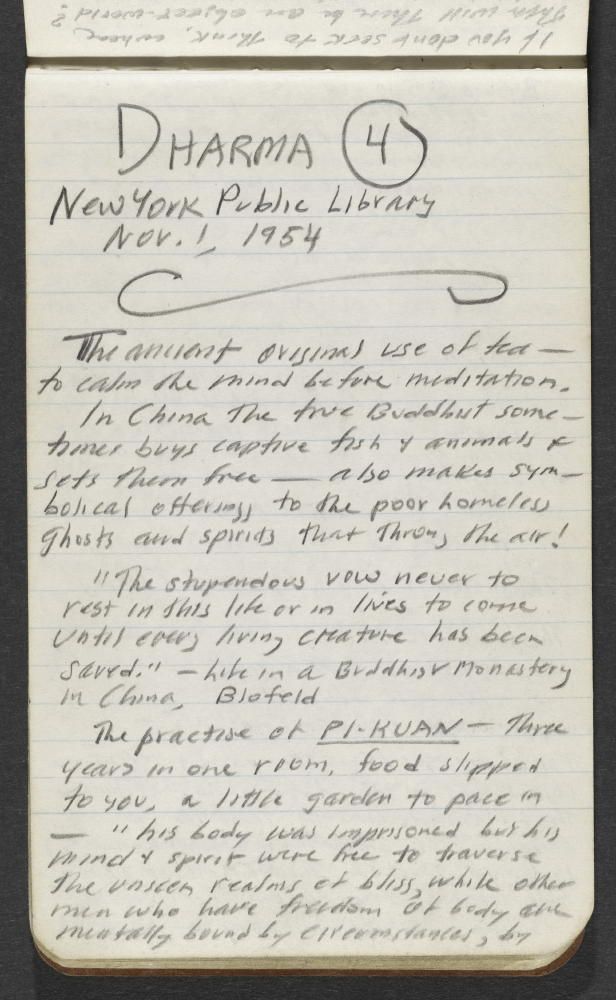
Jack Kerouac's notebook

According to Regina Weinreich in her introduction to Kerouac’s Book of Haikus, Kerouac scribbled haiku in “small bound notebooks—the kind he would press into his checkered lumberman’s shirt pocket and carry around anywhere for fresh and spontaneous entries.” Weinreich also mentions that Kerouac began writing haiku as a kind of literary sketchbook that he carried with him as he wandered the streets of New York and San Francisco and the highways of the United States.
The spontaneity of haiku seemed to Kerouac a perfect match for the improvisations of jazz.

Al Cohn, Jack Kerouac, Zoot Sims

Kerouac recorded a wonderful album of Blues & Haikus with the celebrated jazz saxophonists Zoot Sims and Al Cohn in 1959. You can hear this album on YouTube. Here are a couple of my favorite Kerouac haiku:

Crossing the football field,
     coming home from work
The lonely businessman

In my medicine cabinet
     the winter fly
Has died of old age

            Wash hung out
     by moonlight
—Friday night in May

Empty baseball field
     —A robin,
Hops along the bench

(haiku copyright © by Jack Kerouac)

What strikes me in listening to all of the haiku that Kerouac recorded on this album—just a fraction of the 1000 haiku he penned in his lifetime—is that these poems do not resemble the Kerouac we tend to think of. The Kerouac of the popular imagination, the Kerouac of On the Road, is an ecstatic adventurer. The haiku of his that I found the most emotionally authentic were the ones that recorded moments of quiet pathos. Maybe my own bias is showing here, but it’s interesting that this East Asian form gave Kerouac permission to show a side of himself that doesn’t emerge much in the pumped-up adventures of his novels.

I’ve chosen these three representative poets from three different regions of the West, who were part of different literary schools, and wrote during different time periods. All three of them were deeply influenced by the writing of East Asia. I call these three writers representative because they are just the tip of the wedge. I could have focused on any number of other poets, from many other countries and literary circles. Countless Western poets have borrowed from the literature of China, Japan, and Korea. By discussing these three writers, I’ve tried to show what an enormous debt the poets of the West owe to the writers of East Asia, and what an essential role East Asian poetry played in the development of literary modernism.

The Influence of East Asian Literature on Western Poetry, Part 1, Introduction
The Influence of East Asian Literature on Western Poetry: Part 3—Less Is More and the Poetry of Jean Follain

Zack’s most recent book of poems, Irreverent Litanies
Zack’s most recent translation, Bérénice 1934–44: An Actress in Occupied Paris by Isabelle Stibbe

Other recent posts on writing topics:

How to Get Published

Getting the Most from Your Writing Workshop
How Not to Become a Literary Dropout
Putting Together a Book Manuscript
Working with a Writing Mentor
How to Deliver Your Message
Does the Muse Have a Cell Phone?
Why Write Poetry? 
Poetic Forms: IntroductionThe SonnetThe SestinaThe GhazalThe TankaThe Villanelle
Praise and Lament
How to Be an American Writer
Writers and Collaboration
Types of Closure in Poetry

Thursday, May 30, 2019

“Good Poets Borrow, Great Poets Steal”

It turns out that T.S. Eliot never said the phrase often attributed to him, “Good poets borrow, great poets steal.” According to a blog I read recently, what Eliot actually said was, “mature poets steal; bad poets deface what they take, and good poets make it into something better, or at least something different.” Either way, the phrase sings the praises of literary theft, which on the surface is an incredibly odd statement, particularly in the realm of the arts, where originality counts for so much.

T.S. Eliot
Eliot might have been thinking of works like his poem “The Waste Land.” That classic is, to a great extent, a collage of snippets “stolen” from a variety of sources, including Richard Wagner’s Tristan und Isolde, what U.K. bartenders say at closing (“HURRY UP PLEASE ITS TIME”), the Upanishads, and dozens of others. For Eliot and the poets who were close to him, like Ezra Pound, borrowing from the literary canon, as they read it, was a necessity, a way of showing that you knew your lineage. But to my mind, there is something terribly elitist about that way of looking at the poet’s calling, since the lineage that those poets acknowledged consisted only of certain types of writings by male poets in the Indo-European tradition, with a bit of Confucius thrown in for good measure.

What the phrase “mature poets steal” means to me is something different from what it meant to Eliot and Pound. At a certain point in my life as a writer, I developed a mania for originality. This was useful when I was attempting to free myself of all the influences that I’d cluttered my work with, when I first began writing. By prizing originality over anything else, I was challenging myself not to sound like T.S. Eliot or Ezra Pound or my favorite poet of the month, but to write from my own voice and experience. Easier said than done—finding that individual calling as a writer is a lifetime’s work.

What that fixation on originality left out was literary community. I eventually came to realize that I could take my work only so far on my own. I needed a community of writers to provide insight into my writing, and to sharpen my abilities as an editor of the work of other writers, and myself. The reality is that one pair of eyes can only see so much. Many pairs of eyes can see a much wider panorama.

I belong to a wonderful writers group that meets once a month for a potluck brunch and a round robin where we all read our latest poems. I hardly trust myself to finish a poem until I’ve run it past that group, called Thirteen Ways, because I highly respect their judgment. Even if I don’t take all their suggestions, I need to hear their reactions to my work to know if I’m headed in the right direction. I also show my work to other peers.

At first I was hesitant to take any specific suggestions that other writers gave me. I was still fixated on the need for originality. In time, I came to realize that finishing well the works I initiated was much more important than my personal claims as the author. If a member of my writing group read a line of mine that fell short in some way, s/he might suggest another wording. Originally I would note that down, but insist on altering the offered wording, to avoid stealing. Now, if I feel that the suggested wording is just what the poem needs and wants, I sometimes take the phrase word for word. It’s much more important for the poem to be as good as it can be, than for me to have written every single word in it. “Mature poets steal.”

Of course, if someone suggested completely rewriting my poem, and gave me all the specifics, I wouldn’t accept that. But one line, or a title?—I thank my lucky stars that I have such good literary friends, and I insert that gift into the poem. I know that I can’t always be the best editor of my own creations, and I am grateful that I have other writers I trust who can help me improve my work when I need it.

_____________________________

Zack’s most recent book of poems, Irreverent Litanies
Zack’s most recent translation, Bérénice 1934–44: An Actress in Occupied Paris by Isabelle Stibbe

How to Get Published
Getting the Most from Your Writing Workshop
How Not to Become a Literary Dropout
Putting Together a Book Manuscript
Working with a Writing Mentor
How to Deliver Your Message
Does the Muse Have a Cell Phone?
Why Write Poetry? 
Poetic Forms: IntroductionThe SonnetThe SestinaThe GhazalThe TankaThe Villanelle
Praise and Lament
How to Be an American Writer
Writers and Collaboration
Types of Closure in Poetry

Thursday, August 18, 2016

How to Be an American Writer, Part 2: Henry James and the Expatriates

Leaving the U.S. for Leverage

U.S. writers have reacted to Puritanical and materialistic trends in American society in various ways. One way is just to get out, otherwise known as being an expatriate, living outside the U.S.

But leaving the country is not just a form of escape. It gives an author an alternative framework and value system to evaluate U.S. society. “Give me a lever and a place to stand, and I will move the world,” Archimedes stated. Well, if the lever in this case is literature, certain authors need a place to stand outside our society in order to have leverage to budge it.

Expatriates Outside England and France

U.S. expatriate writers have mostly gravitated to England and France, with some exceptions. There have been a few American writers who have clustered in Morocco, such as Paul and Jane Bowles, and William Burroughs. There’s also Ezra Pound grumbling at the Grand Canal in Venice. The poet Cid Corman lived for many decades in Kyoto, Japan, running an ice cream and cake store with his wife. (I had a letter of introduction to Cid Corman when I visited Japan in 1986, and he asked me to meet him at the store, where I was hoping to learn from his many years of experience as a writer—mostly I learned about ice cream). But, in general, the refined and urbane cultures of the U.K. and Paris have been the draw.

Henry James, the Quintessential Expatriate

To me, the quintessential American expatriate writer is Henry James. James, who was born in 1843, spent much of his life in Europe, including a lot of his childhood. He came from a stellar family. His older brother was the philosopher of spirituality William James. His younger sister was the diarist Alice James—the literary press Alice James Books is named for her.

Henry James
Henry James ultimately purchased and renovated an eighteenth century house in the town of Rye in Sussex in the U.K., where he settled and lived his last twenty years, till his death in 1916.

Henry James wrote twenty-three novels, scores of short stories, many books of criticism and travel writing, and several plays. When I was assigned his novel The Ambassadors in college, I dismissed him as something of a fuddy-duddy. James writes in a way that can seem overly formal these days. Few of his sentences would fit on the screen of a smartphone or a phablet. His plots move as slowly as a rowboat crossing the Atlantic Ocean. I just didn’t have the patience when I was younger to wait him out.

Getting to Henry James by Way of Tehran

My interest in James was finally kindled, oddly enough, by way of Iran. A couple of years ago I read Azar Nafisi’s book Reading Lolita in Tehran. In this engaging memoir, Nafisi tells the story of a secret study group of Muslim women who met in her home in Iran after the Islamic Revolution in the late 1970s, defying the 1984-like rules of a government that literally burns books. These women risked prison merely by taking part in a reading group.


Interestingly, one of the writers who spoke most directly to these young women, forced to wear the burka in the streets, was Henry James. James created bold women characters like Daisy Miler who weren’t afraid to flaunt convention by going on an outing in public with a man who is not a family member. This was the sort of “crime” that these women in Tehran were sometimes accused of. The penalty in Iran if caught was to be whipped and ostracized from society. For the women of this reading group, Henry James was a profoundly revolutionary writer. In reading about the lives of these women in Iran, I realized how shocking James was for the readers of his day—not that whipping was a common penalty in New England in 1900, but ostracism was certainly a danger.

The Ambassadors

Among James’s subversive women characters is Maria Gostrey in The Ambassadors. Maria is a free spirit, a woman in her thirties who lives by herself in England. That sort of life is almost unimaginable to the novel’s main character, Lambert Strether. His fiancée, a widow from a powerful banking family in the fictional town of Woollett, Massachusetts, sends Strether, the “ambassador,” to France to bring back home her wayward son, Chad. Chad has spent entirely too much time sipping delicious burgundies, eating triple cream cheeses, browsing painting exhibitions, and worst of all, consorting with a widowed French woman who is older than he is. Strether’s mission is to yank this young man back to Woollett, where he is supposed do what all young men of his class are destined for: marry a girl from a family just like his and make gobs of money.

When Strether first meets the freewheeling Maria Gostrey, there is an interesting culture clash, where American enterprise meets the good life of Europe. To begin with, she suggests they go for a walk together in the garden of the hotel where they're both staying Remember, she is an unmarried woman. Here’s how James describes their encounter:

He looked repeatedly at his watch, and when he had done so for the fifth time Miss Gostrey took him up.
“You’re doing something that you think not right.”
It so touched the place that he quite changed color, and his laugh was almost awkward. “Am I enjoying it as much as that?”
“You’re not enjoying it, I think, so much as you ought.”
“I see”he appeared thoughtfully to agree. “Great is my privilege.”
“Oh, it’s not your privilege! It has nothing to do with me. It has to do with yourself. Your failure’s general.”
“Ah, there you are!” he laughed. “It’s the failure of Woollett. That’s general.”
“The failure to enjoy,” Miss Gostrey explained, “is what I mean.”

The failure to enjoy. I think James hit the nail on the head there. The problem with puritanical, entrepreneurial culture in the U.S. is that there is really no space for enjoying the pleasures of an individual’s choosing.

Another book that deepened my appreciation of Henry James is a recent novel about James’s life in Europe called The Master by the Irish writer Colm Tóibín. I recommend it if you are at all interested in James.

In my next blog, I’ll talk about the American expatriate writers of the 1920s like Fitzgerald and Hemingway; the lesbian, gay, and bisexual side of the expatriate literary world; and contemporary expatriates such as David Sedaris.

Other recent posts about writing topics: 
How to Be an American Writer, Part 1Part 2Part 3Part 4Part 5Part 6Part 7Part 8