Showing posts with label Kenneth Rexroth. Show all posts

Thursday, September 19, 2019

The Influence of East Asian Literature on Western Poetry: Part 4—Jack Kerouac’s Haiku; and Conclusion

The last poet I’m going to talk about is Jack Kerouac, who lived from 1922 to 1969. Kerouac is better known as a fiction writer, and he was the scribe of the Beat Generation. The Beats were a group of writers and artists who burst on the American scene in the city where I live, San Francisco, in 1955.

Beat Generation writers: Jack Kerouac, Allen Ginsberg, William Burroughs 

They were rebels who rejected the materialism of the post-World War II era in the West, and favored dropping out of society to experience authentic life through road trips, jazz clubs, altered consciousness, and amorous adventures. The most famous text of the Beat Generation is Jack Kerouac’s novel On the Road, an account of a car trip through the United States and Mexico.

Manuscript of Jack Kerouac's On the Road

 
Kerouac typed this book on a continuous scroll of paper, unedited. On the surface, this novel is extremely American, but like much in Kerouac’s work, it has East Asian roots.
East Asian literature came to the Beat Generation through a complicated family tree. It’s a lineage that can also be traced back to Judith Gautier’s Le Livre de jade, which was known to the U.S. poet Ezra Pound. Pound created his own anthology of East Asian poetry, which he called Cathay and published in 1915. Cathay was an enormously influential book in the United States, and it profoundly affected the San Francisco poet Kenneth Rexroth, who was the literary mentor of the Beat Generation writers. 
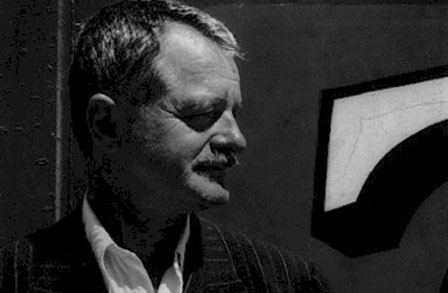
Kenneth Rexroth (1905–1982)

Rexroth created his own anthologies of East Asian writing, which were very popular:
One Hundred Poems from the Japanese, published in 1955, followed the next year by One Hundred Poems from the Chinese; and for good measure, 100 More Poems from the Japanese in 1976, not to mention Orchid Boat: Women Poets of China and The Burning Heart: Women Poets of Japan.
Rexroth’s interest in East Asian poetry also dovetailed with that of Beat Generation writer Gary Snyder, immortalized in The Dharma Bums, Jack Kerouac’s roman à clef. Gary Snyder not only read Chinese and Japanese, he lived in Japan in the late 1950s and early 1960s, and translated the Cold Mountain Poems of T’ang Dynasty poet Han Shan.
For the Beat Generation writers, it seems to me the quality that they were seeking in East Asian literature was spontaneity. Spontaneous action was something that the materialist culture of shopping mall, yes-man America did not favor. The Beat Generation writers admired that belief in inspiration in the moment in East Asian writing, and the related Buddhist practice of remaining conscious of the present, another alternative to 1950s consumerism.
Jack Kerouac’s persona in The Dharma Bums begins writing haiku under the inspiration of the character based on Gary Snyder. Kerouac was also reading the four-volume translation of haiku by R.H. Blythe, simply titled Haiku.
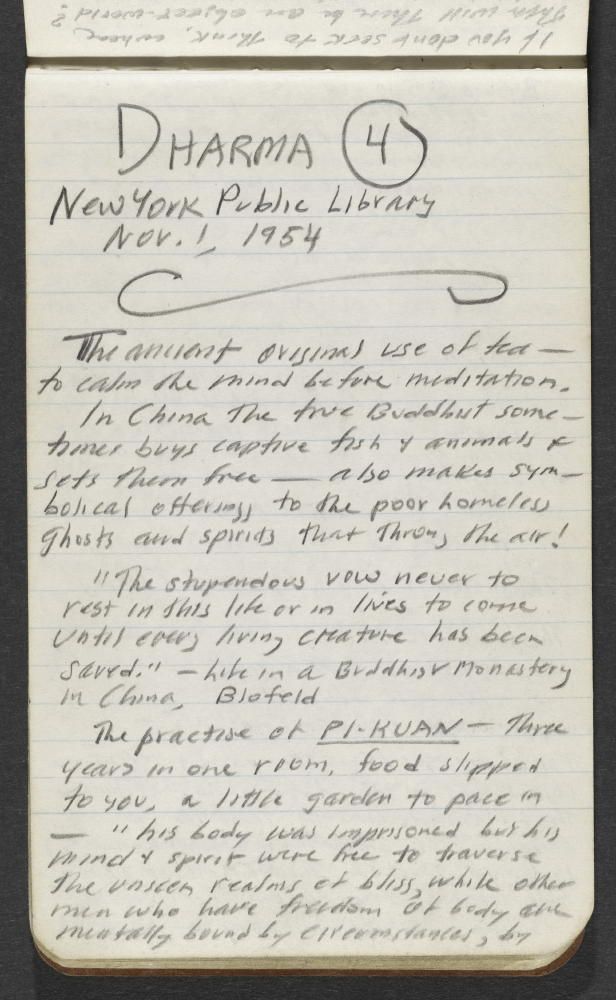
Jack Kerouac's notebook

According to Regina Weinreich in her introduction to Kerouac’s Book of Haikus, Kerouac scribbled haiku in “small bound notebooks—the kind he would press into his checkered lumberman’s shirt pocket and carry around anywhere for fresh and spontaneous entries.” Weinreich also mentions that Kerouac began writing haiku as a kind of literary sketchbook that he carried with him as he wandered the streets of New York and San Francisco and the highways of the United States.
The spontaneity of haiku seemed to Kerouac a perfect match for the improvisations of jazz.

Al Cohn, Jack Kerouac, Zoot Sims

Kerouac recorded a wonderful album of Blues & Haikus with the celebrated jazz saxophonists Zoot Sims and Al Cohn in 1959. You can hear this album on YouTube. Here are a couple of my favorite Kerouac haiku:

Crossing the football field,
     coming home from work
The lonely businessman

In my medicine cabinet
     the winter fly
Has died of old age

            Wash hung out
     by moonlight
—Friday night in May

Empty baseball field
     —A robin,
Hops along the bench

(haiku copyright © by Jack Kerouac)

What strikes me in listening to all of the haiku that Kerouac recorded on this album—just a fraction of the 1000 haiku he penned in his lifetime—is that these poems do not resemble the Kerouac we tend to think of. The Kerouac of the popular imagination, the Kerouac of On the Road, is an ecstatic adventurer. The haiku of his that I found the most emotionally authentic were the ones that recorded moments of quiet pathos. Maybe my own bias is showing here, but it’s interesting that this East Asian form gave Kerouac permission to show a side of himself that doesn’t emerge much in the pumped-up adventures of his novels.

I’ve chosen these three representative poets from three different regions of the West, who were part of different literary schools, and wrote during different time periods. All three of them were deeply influenced by the writing of East Asia. I call these three writers representative because they are just the tip of the wedge. I could have focused on any number of other poets, from many other countries and literary circles. Countless Western poets have borrowed from the literature of China, Japan, and Korea. By discussing these three writers, I’ve tried to show what an enormous debt the poets of the West owe to the writers of East Asia, and what an essential role East Asian poetry played in the development of literary modernism.

The Influence of East Asian Literature on Western Poetry, Part 1, Introduction
The Influence of East Asian Literature on Western Poetry: Part 3—Less Is More and the Poetry of Jean Follain

Zack’s most recent book of poems, Irreverent Litanies
Zack’s most recent translation, Bérénice 1934–44: An Actress in Occupied Paris by Isabelle Stibbe

Other recent posts on writing topics:

How to Get Published

Getting the Most from Your Writing Workshop
How Not to Become a Literary Dropout
Putting Together a Book Manuscript
Working with a Writing Mentor
How to Deliver Your Message
Does the Muse Have a Cell Phone?
Why Write Poetry? 
Poetic Forms: IntroductionThe SonnetThe SestinaThe GhazalThe TankaThe Villanelle
Praise and Lament
How to Be an American Writer
Writers and Collaboration
Types of Closure in Poetry

Sunday, September 15, 2019

The Influence of East Asian Literature on Western Poetry: Part 3—Less Is More and the Poetry of Jean Follain


Western artists and writers have pulled from the tradition of East Asia for another reason: brevity, conciseness, and simplicity.

Mies van der Rohe architecture: “Less is more.”

From the sketches of Pablo Picasso, to the four-word stanzas of William Carlos Williams’s “The Red Wheelbarrow,” to the “Less is more” steel and glass geometry of Mies van der Rohe’s architecture, this aspect of the aesthetic of East Asia has opened up new possibilities in the art of the West. Traditionally, ornateness and opulence were more or less synonymous with artistry in Europe.

Medieval ivory carving, Louvre Museum
Think of the highly populated worlds of medieval ivory carvings, and the intricacies of such forms as the sestina, not to mention Tolstoy’s novels, requiring an index of the myriad of characters.
Enter the purity of East Asian art, influenced by the sensibility of Buddhism, particularly Zen.

Moon jar, South Korea
In poetry, this aesthetic is most pronounced in such forms as the tanka or waka, which creates the fulcrum of a story in only thirty-one syllables. And of course there’s haiku, which gives the readers a moment of heightened awareness in only seventeen syllables.
Even though the initial translations of East Asian poetry into European languages were in French, the aesthetic of East Asian poetry was slower to influence Paris modernism. In France, the new writing of the early twentieth century was closely linked to the subconscious, and the subconscious requires free association. Free association often takes the form of long lines or prose poems that allow for an outpouring of imagery, as in the writing of Guillaume Apollinaire or André Breton. The extended lines of Walt Whitman were more of an influence for the French modernists than the poets of East Asia.
To my mind, the French modernist who shows the greatest influence of East Asian writing is the poet Jean Follain, who lived from 1903 to 1971.

Jean Follain, French poet (1903–1971)

Follain, unlike many of his contemporaries, was not a follower of “isms.” In fact, in contrast to many of the revolutionary French writers of his time, he worked as a lawyer and then as a district judge. Many of the artists of his era flocked to the artistic center of Paris, where the cafes were continually churning out new literary movements. The great urban centers can sometimes be surprisingly provincial in their insistence on embracing the latest avant-garde. But Follain lived much of his life in the provinces, in the little town of Canisy in Normandy, in the north of France.


Canisy, Normandy, France

He was somewhat isolated from other French writers. This may be one of the reasons that he was open to influences outside Europe, particularly East Asian writing.
For Follain, the short line and the poem of few words becomes a way of sketching the fates of living beings, much the same way that a haiku or tanka poem can.

Here, for example, is Follain’s poem “Dog with Schoolboys”:

Dog with Schoolboys

For fun the schoolboys crack the ice
along a path
next to the railroad
they are heavily clothed
in dark old woolens
belted with beat leather
The dog that follows them
no longer has a bowl to eat from
he is old
for he is their age.

(translation copyright © by Keith Waldrop)

This poem is almost a Zen koan. It presents the odd spectacle of schoolboys wandering by themselves, ostensibly having fun, but there is way too much silence and emptiness in this poem for their amusement to be anything but a way to heighten the pathos. Something about the schoolboys “dark old woolens” and “beat leather” suggests anything but a carefree childhood, and may even imply domestic violence.
Follain holds off on introducing the dog until the last four lines. Unlike the boys, the dog is homeless. The last two lines are understated but shot through with emotion: “he is old/for he is their age.” The paradox is that for a dog, the age of twelve or thirteen is past middle age, while the boys are the same age but still young. And yet…we sense that there is something old about these boys, repeating the ageless pranks that schoolboys have always played, in worn-out clothing, like the garb of old men. They are next to a railroad track, but ironically, they are not going anywhere. Their lives, like that of the homeless dog, are laid out before them, and those fates seem anything but promising. “Dog with Schoolboys” is a poem that shifts rapidly in perspective, and opens a sort of bottomless, emotional trapdoor at the end. It reminds me of the very famous Japanese haiku by Ransetsu:

Hattori Ransetsu, Japanese poet (1654–1707)

The childless woman,
How tender she is
To the dolls!

(translated by R.H. Blythe)

In Ransetsu’s haiku, he also sets the scene, and then suddenly pulls the rug out from under the reader, leaving only pathos. Ironically, the non-human world evokes human loneliness.
Follain’s “Dog with Schoolboys” also reminds me of those great tanka poems where there are two separate sections, connected only metaphorically. I’m thinking, for example, of this classic by the 10th century poet Fujiwara no Toshiyuki:

Fujiwara no Toshiyuki, tenth century C.E. Japanese poet

waves crowd the shore
Even at night
by the corridors of dreams
I come to you secretly

(adapted from the translation of Kenneth Rexroth)


The poet allows the reader to make the connection between the waves crowding the shore and the speaker, who is visiting his beloved in a dream. It is only on reflection that we realize that the waves could be a metaphor for the speaker in the dream. That wonderful phrase “crowd the shore” tells us that a love that penetrates even to dreams is a bit overbearing.
Follain draws on this sort of metaphorical tanka in his poetry, often presenting two or three or more elements in his poems that seem unrelated. It’s up to the reader to place these elements in a continuum along an axis, and to figure out what that axis is. Follain borrowed from East Asian poetry to create a poetics where the reader has to solve the puzzle.


Zack’s most recent book of poems, Irreverent Litanies
Zack’s most recent translation, Bérénice 1934–44: An Actress in Occupied Paris by Isabelle Stibbe

Other recent posts on writing topics:

How to Get Published

Getting the Most from Your Writing Workshop
How Not to Become a Literary Dropout
Putting Together a Book Manuscript
Working with a Writing Mentor
How to Deliver Your Message
Does the Muse Have a Cell Phone?
Why Write Poetry? 
Poetic Forms: IntroductionThe SonnetThe SestinaThe GhazalThe TankaThe Villanelle
Praise and Lament
How to Be an American Writer
Writers and Collaboration
Types of Closure in Poetry

Wednesday, September 12, 2012

Using Poetic Forms, Part 5: The Tanka

Many know about haiku, that ultra-short form of poetry from Japan that captures a flash of consciousness in only three lines. But a thousand years before haiku was created, Japanese poets developed and perfected the tanka form. Tanka is slightly longer—five lines—but it’s significantly different from haiku in the type of moment that sparks it.

Like haiku, which crystallizes one specific moment in time or consciousness, tanka is about a particular observation of the poet. But unlike haiku, tanka can reach both backwards and forwards in time to include a broader observation, or even a story. How can just five short lines of poetry tell a narrative? It’s not easy, but with the conciseness of tanka, a poet finds the fulcrum of a story, the moment of truth in that encounter.  Here’s one of my favorite tanka poems, by the great Japanese woman poet Yosano Akiko, who lived from 1878 to 1942, and wrote over 50,000 poems:

early evening moon
rising over a field of flowers
somehow I knew
he was waiting for me
and I went to him

(translated by Leith Morton and Zack Rogow)

Here the poet describes the moment when she made her choice to embark on a difficult relationship. The image of the evening moon suggests the expectant lover, wishing for her. The field of flowers makes me think of the fullness of her love.

I haven’t said anything yet about the rigorous form of the tanka. In Japanese, each of the five lines must have a specific number of syllables. The number of syllables per line is: 5-7-5-7-7. I haven’t mentioned this because this form works beautifully in Japanese, but when English-language translators or poets attempt to duplicate the form exactly, it often takes away from the freshness and the gentle punch of the tanka. Personally, I prefer poems that follow the spirit of the tanka and don’t count syllables like pennies. On the other hand, if you’re up to twelve syllables per line, you’re losing the concentrated flavor of the language in tanka.

Another fascinating side of the tanka is that the poet often sharply splits the five lines between two seemingly unrelated images. The writer does not directly link these two worlds, but leaves it entirely up to the reader to make the connection. Yosano Akiko does this in the poem just cited about the moon over the evening field and the lover’s impulse. Here’s another example, a thousand-year-old tanka by the 10th century poet Fujiwara no Toshiyuki:

in the Bay of Sumi
waves crowd the shore
even at night
by the corridors of dreams
I come to you secretly

(adapted from the translation of Kenneth Rexroth)

The poet never says that the waves are like him, the lover. He never directly mentions that the shore is a metaphor for his beloved. It’s all just understood. That’s what I love about it! And the fact that the waves are not simply approaching the shore, they are crowding it. It is a little invasive to tell your beloved that you can visit her at night, even when she’s dreaming. The poem acknowledges that, in the midst of a wonderfully romantic moment. That’s an amazing amount of emotional complexity to pack into five lines.

Another classic tanka that I love is one by Ariwara no Narihira, who lived from 825 to 880 C.E.:

I always knew
that I would take this road
but yesterday
I didn’t know
it would be today

(adapted from the translation of Kenneth Rexroth)

There are so many amazing things about this poem—the ease and simplicity of the metaphor of the road, the way the poem can be applied to a myriad of situations, the way it doesn't hit you till the last line. Beautiful! 

If you’d like to read more tanka, here are some collections of the form:

Kenneth Rexroth, One Hundred Poems from the Japanese
Makoto Ueda, Modern Japanese Tanka
Yosano Akiko, Tangled Hair: Selected Poems from Midaregami

Poetic Forms: IntroductionThe SonnetThe SestinaThe GhazalThe TankaThe Villanelle

Zack's own tanka poems appear in his books Irreverent Litanies and My Mother and the Ceiling Dancers.