The
last poet I’m going to talk about regarding the influence of Eastern poetry on Western writers is Jack Kerouac, who lived from 1922 to 1969. Kerouac is better known as a fiction writer. He was also the
scribe of the Beat Generation. The Beats were a group of writers and artists
who burst on the American scene in 1955 in the city near where I live, San Francisco.
 |
| Beat Generation writers: Jack Kerouac, Allen Ginsberg, William Burroughs |
The Beats were rebels who rejected the materialism of the post-World War II era in the West, and favored dropping out of society to experience authentic life through road trips, jazz clubs, altered consciousness, and amorous adventures. The most famous text of the Beat Generation is Jack Kerouac’s novel On the Road, an account of a car trip through the United States and Mexico.
 |
| Manuscript of Jack Kerouac's On the Road |
East
Asian literature came to the Beat Generation through a complicated family tree. It’s
a lineage that can also be traced back to Judith Gautier’s French-language anthology of Eastern poetry, Le Livre de jade, published in 1867. Le Livre de jade was known to the U.S. poet Ezra Pound.
Pound then created his own anthology of East Asian poetry, which he called Cathay, published in 1915. Cathay was an enormously influential
book in the United States, and it profoundly affected the San Francisco poet
Kenneth Rexroth, who was the literary mentor of the Beat Generation writers.
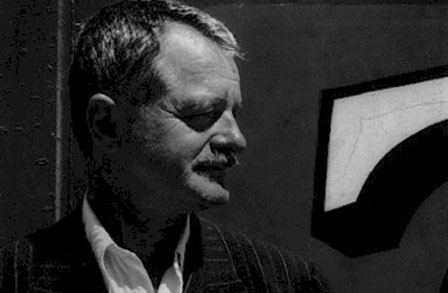 |
| Kenneth Rexroth (1905–1982) |
Rexroth created his own anthologies of East Asian writing, which were very popular: One Hundred Poems from the Japanese, published in 1955, followed the next year by One Hundred Poems from the Chinese; and for good measure, 100 More Poems from the Japanese in 1976, not to mention Orchid Boat: Women Poets of China and The Burning Heart: Women Poets of Japan.
Rexroth’s
interest in East Asian poetry also dovetailed with that of Beat Generation
writer Gary Snyder, immortalized in The
Dharma Bums, Jack Kerouac’s roman à
clef. Gary Snyder not only read Chinese and Japanese, he lived in Japan in
the late 1950s and early 1960s, and translated the Cold Mountain Poems of T’ang Dynasty poet Han Shan.
For
the Beat Generation writers, it seems to me the qualities that they were seeking
in East Asian literature were spontaneity and mindfulness. Spontaneous action was something that
the materialist culture of shopping mall, yes-man America did not favor. The
Beat Generation writers admired the belief in inspiration in the moment in East Asian
writing, and the related Buddhist practice of remaining conscious of the present, another dramatic alternative to the acquisition-based consciousness of 1950s consumerism.
Jack
Kerouac’s persona in The Dharma Bums
begins writing haiku under the inspiration of the character based on Gary
Snyder. Kerouac was also reading the four-volume translation of haiku by R.H.
Blythe, simply titled Haiku.
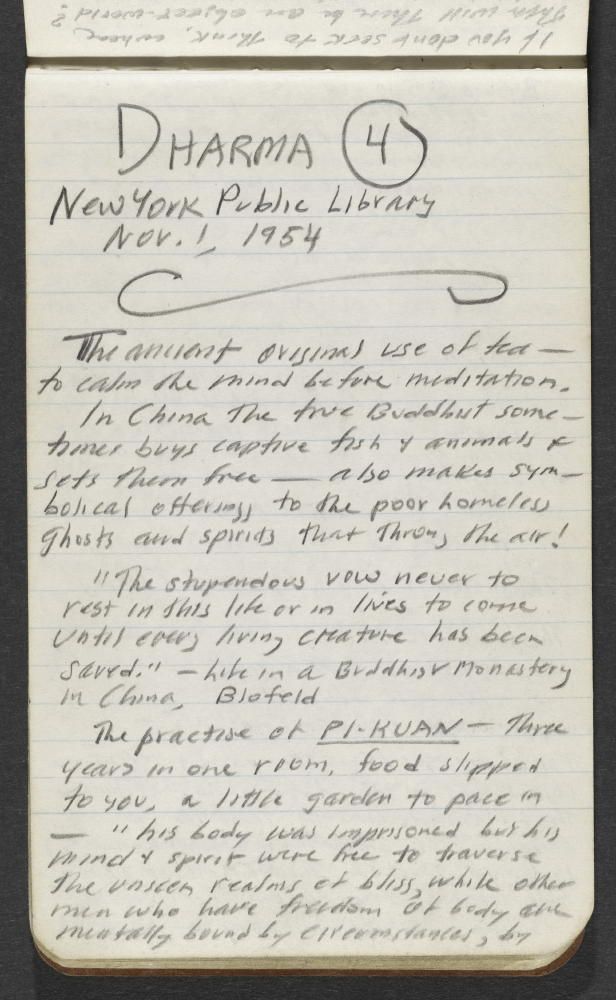 |
| Jack Kerouac's notebook |
According to Regina Weinreich in her introduction to Kerouac’s Book of Haikus, Kerouac scribbled haiku in “small bound notebooks—the kind he would press into his checkered lumberman’s shirt pocket and carry around anywhere for fresh and spontaneous entries.” Weinreich also mentions that Kerouac began writing haiku as a kind of literary sketchbook that he carried with him as he wandered the streets of New York and San Francisco and the highways of the United States.
The
spontaneity of haiku seemed to Kerouac a perfect match for the improvisations
of jazz.
 |
| Al Cohn, Jack Kerouac, Zoot Sims |
Kerouac recorded a wonderful album of Blues & Haikus with the celebrated jazz saxophonists Zoot Sims and Al Cohn in 1959. You can hear this album on YouTube. Here are a couple of my favorite Kerouac haiku:
Crossing the football field,
coming home from work
The lonely businessman
In my medicine cabinet
the winter fly
Has died of old age
Wash hung out
Wash hung out
by moonlight
—Friday night in May
Empty baseball field
—A robin,
Hops along the bench
(haiku copyright © by Jack Kerouac)
What
strikes me in listening to all the haiku that Kerouac recorded on this
album—just a fraction of the 1000 haiku he penned in his lifetime—is that these
poems do not resemble the Kerouac we tend to think of. The Kerouac of the
popular imagination, the Kerouac of On
the Road, is an ecstatic adventurer. The haiku of his that I found the most
emotionally authentic were the ones that recorded moments of quiet pathos.
Maybe my own bias is showing here, but it’s interesting that this East Asian
form gave Kerouac permission to show a side of himself that doesn’t emerge much
in the pumped-up adventures of his novels.
For my series of posts on Western poets influenced by Eastern writing, I’ve
chosen these three representative poets from three different regions of the
Occident, who were part of different literary schools, and wrote during different
time periods. All three of them were deeply influenced by the writing of East
Asia. I call these three writers representative because they are just the tip
of the wedge. I could have focused on any number of other poets, from many
other countries and literary circles. Countless Western poets have borrowed from
the literature of China, Japan, and Korea. By discussing these three writers,
I’ve tried to show what an enormous debt the poets of the West owe to the
writers of East Asia, and what an essential role East Asian poetry played in
the development of literary modernism.
_______________________________
Zack’s new book of poetry, The Kama Sutra for Senior Citizens and Other Poems on Aging.
Order in the USA Order in the UK
Zack’s most recent translation:
The Water Drinkers and Other Sketches of Paris in the Romantic Era by Henry Murger
Other posts of interest:
Getting the Most from Your Writing Workshop
How Not to Become a Literary Dropout
Putting Together a Book Manuscript
Does the Muse Have a Cell Phone?
Poetic Forms: Introduction, the Sonnet, the Sestina, the Ghazal, the Tanka, the Villanelle

No comments:
Post a Comment