Showing posts with label Jack Kerouac. Show all posts

Thursday, September 19, 2019

The Influence of East Asian Literature on Western Poetry: Part 4—Jack Kerouac’s Haiku; and Conclusion

The last poet I’m going to talk about regarding the influence of Eastern poetry on Western writers is Jack Kerouac, who lived from 1922 to 1969. Kerouac is better known as a fiction writer. He was also the scribe of the Beat Generation. The Beats were a group of writers and artists who burst on the American scene in 1955 in the city near where I live, San Francisco.

Beat Generation writers: Jack Kerouac, Allen Ginsberg, William Burroughs 

The Beats were rebels who rejected the materialism of the post-World War II era in the West, and favored dropping out of society to experience authentic life through road trips, jazz clubs, altered consciousness, and amorous adventures. The most famous text of the Beat Generation is Jack Kerouac’s novel On the Road, an account of a car trip through the United States and Mexico.

Manuscript of Jack Kerouac's On the Road

 
Kerouac typed this book on a continuous scroll of paper, unedited. On the surface, this novel is extremely American, but like much in Kerouac’s work, it has East Asian roots.
East Asian literature came to the Beat Generation through a complicated family tree. It’s a lineage that can also be traced back to Judith Gautier’s French-language anthology of Eastern poetry, Le Livre de jade, published in 1867. Le Livre de jade was known to the U.S. poet Ezra Pound. Pound then created his own anthology of East Asian poetry, which he called Cathay, published in 1915. Cathay was an enormously influential book in the United States, and it profoundly affected the San Francisco poet Kenneth Rexroth, who was the literary mentor of the Beat Generation writers. 
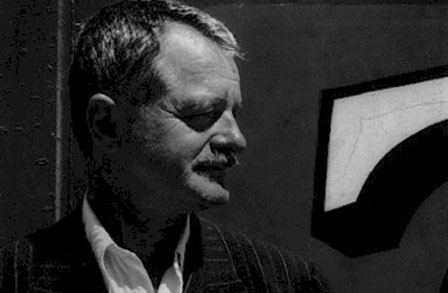
Kenneth Rexroth (1905–1982)

Rexroth created his own anthologies of East Asian writing, which were very popular:
One Hundred Poems from the Japanese, published in 1955, followed the next year by One Hundred Poems from the Chinese; and for good measure, 100 More Poems from the Japanese in 1976, not to mention Orchid Boat: Women Poets of China and The Burning Heart: Women Poets of Japan.
Rexroth’s interest in East Asian poetry also dovetailed with that of Beat Generation writer Gary Snyder, immortalized in The Dharma Bums, Jack Kerouac’s roman à clef. Gary Snyder not only read Chinese and Japanese, he lived in Japan in the late 1950s and early 1960s, and translated the Cold Mountain Poems of T’ang Dynasty poet Han Shan.
For the Beat Generation writers, it seems to me the qualities that they were seeking in East Asian literature were spontaneity and mindfulness. Spontaneous action was something that the materialist culture of shopping mall, yes-man America did not favor. The Beat Generation writers admired the belief in inspiration in the moment in East Asian writing, and the related Buddhist practice of remaining conscious of the present, another dramatic alternative to the acquisition-based consciousness of 1950s consumerism.
Jack Kerouac’s persona in The Dharma Bums begins writing haiku under the inspiration of the character based on Gary Snyder. Kerouac was also reading the four-volume translation of haiku by R.H. Blythe, simply titled Haiku.
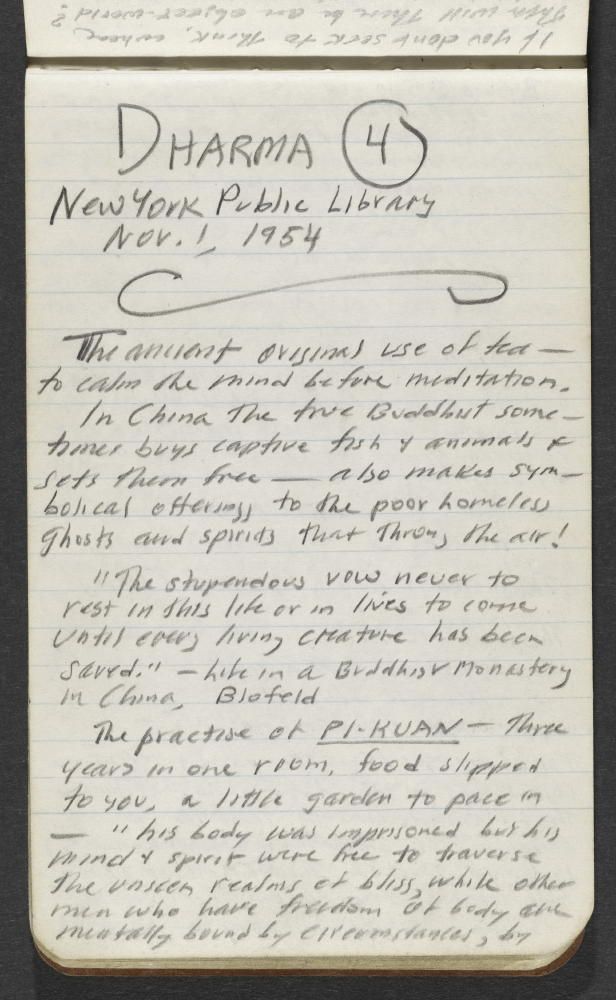
Jack Kerouac's notebook

According to Regina Weinreich in her introduction to Kerouac’s Book of Haikus, Kerouac scribbled haiku in “small bound notebooks—the kind he would press into his checkered lumberman’s shirt pocket and carry around anywhere for fresh and spontaneous entries.” Weinreich also mentions that Kerouac began writing haiku as a kind of literary sketchbook that he carried with him as he wandered the streets of New York and San Francisco and the highways of the United States.
The spontaneity of haiku seemed to Kerouac a perfect match for the improvisations of jazz.

Al Cohn, Jack Kerouac, Zoot Sims

Kerouac recorded a wonderful album of Blues & Haikus with the celebrated jazz saxophonists Zoot Sims and Al Cohn in 1959. You can hear this album on YouTube. Here are a couple of my favorite Kerouac haiku:

Crossing the football field,
     coming home from work
The lonely businessman

In my medicine cabinet
     the winter fly
Has died of old age

            Wash hung out
     by moonlight
—Friday night in May

Empty baseball field
     —A robin,
Hops along the bench

(haiku copyright © by Jack Kerouac)

What strikes me in listening to all the haiku that Kerouac recorded on this album—just a fraction of the 1000 haiku he penned in his lifetime—is that these poems do not resemble the Kerouac we tend to think of. The Kerouac of the popular imagination, the Kerouac of On the Road, is an ecstatic adventurer. The haiku of his that I found the most emotionally authentic were the ones that recorded moments of quiet pathos. Maybe my own bias is showing here, but it’s interesting that this East Asian form gave Kerouac permission to show a side of himself that doesn’t emerge much in the pumped-up adventures of his novels.

For my series of posts on Western poets influenced by Eastern writing, I’ve chosen these three representative poets from three different regions of the Occident, who were part of different literary schools, and wrote during different time periods. All three of them were deeply influenced by the writing of East Asia. I call these three writers representative because they are just the tip of the wedge. I could have focused on any number of other poets, from many other countries and literary circles. Countless Western poets have borrowed from the literature of China, Japan, and Korea. By discussing these three writers, I’ve tried to show what an enormous debt the poets of the West owe to the writers of East Asia, and what an essential role East Asian poetry played in the development of literary modernism.

The Influence of East Asian Literature on Western Poetry, Part 1, Introduction
The Influence of East Asian Literature on Western Poetry: Part 3—Less Is More and the Poetry of Jean Follain
_______________________________
Zack’s new book of poetry, The Kama Sutra for Senior Citizens and Other Poems on Aging. Order in the USA    Order in the UK
Other posts of interest:

How to Get Published

Getting the Most from Your Writing Workshop

How Not to Become a Literary Dropout

Putting Together a Book Manuscript

Working with a Writing Mentor

How to Deliver Your Message

Does the Muse Have a Cell Phone?

Why Write Poetry?

Poetic Forms: Introduction, the Sonnet, the Sestina, the Ghazal, the Tanka, the Villanelle

Praise and Lament

How to Be an American Writer

Writers and Collaboration

Types of Closure in Poetry


Thursday, September 5, 2019

The Influence of East Asian Literature on Western Poetry: Part 1—Le Japonisme and Le Livre de Jade

The influence of East Asian literature on Western poetry is international and widespread. This influence bridges a variety of artistic movements that seem unrelated or even antithetical at first. You might even say the influence of East Asian literature is a defining quality of modernism in the West. 
In this series of blogs, I’m going to talk about three modern writers whose work was shaped in different ways by the writing of East Asia.
These poets from different parts of the world all used East Asian literature as an inspiration to move their own work forward in ways that would not have been possible without this literary legacy. The three writers are the Russian poet Anna Akhmatova; the French modernist poet Jean Follain; and the U.S. writer of the Beat Generation, Jack Kerouac.
How did East Asian literature begin finding its way into the West? In the late nineteenth century, particularly in France, there was a craze, a hunger for all things East Asian. This artistic sensibility had a name. It was called Le Japonisme, or Japonism, although it referred not only to the arts in Japan but to all of East Asian art.
I first became aware of the depth of this influence when I toured the home of the Impressionist painter Claude Monet in Giverny, France.

Japanese prints in Claude Monet’s home, Giverny, France
I’m sure you’ve seen the images of the Japanese-style moon bridge in his garden that Monet painted almost obsessively. But when you enter Monet’s house, the influence of East Asian art is even more evident. Every image on every wall is a Japanese print of the Ukiyo-e masters. Monet owned no fewer than 117 Japanese prints, works by the artists Utamaro, Hiroshige, and Hokusai. 
We could easily trace the same line of influence from East Asian art to the paintings of Vincent Van Gogh:

Vincent van Gogh painting based on a Japanese print
or the posters of Henri Toulouse-Lautrec, just to give a few examples.
But what does this influence in the visual arts have to do with literature? There was a literary Japonisme as well, a craze for all things East Asian in poetry.
This interest in East Asia became particularly popular with Judith Gautier’s Le Livre de jade: poésies traduites du chinois [The Book of Jade: Poetry Translated from the Chinese].


The Book of Jade is a volume of classical Chinese verse translated into French, with illustrations and reproductions of prints and calligraphy. 


Gautier’s anthology made an enormous splash when it was first published in Paris in 1902, but it was not the first or the only one of its kind. There have been many books that have popularized Eastern poetry for the West, published at key moments. Even before Le Livre de jade, collections of Chinese and Japanese classical poetry started appearing in France as early as 1862, with the Marquis de Saint-Denys’ Poésies de l’époque des Thang [Tang Dynasty Poetry], published in Paris.

An anthology of Japanese poetry appeared in Paris in 1871: Anthologie japonaise: poésies anciennes et modernes [A Japanese Anthology: Ancient and Modern Poetry], edited by Léon de Rosny. This collection featured a number of traditional tanka or waka, including poems with the typical subject of a lover waiting in vain for a beloved, a topic that we will see popping up in Western poetry as well.

The Influence of East Asian Literature on Western Poetry: Part 2: The Akhmatova Bridge
The Influence of East Asian Literature on Western Poetry, Part 3: Less Is More and the Poetry of Jean Follain
The Influence of East Asian Literature on Western Poetry: Part 4—Jack Kerouac’s Haiku; and Conclusion

This series of blogs was originally written as a talk for the First Asian Literature Festival, Gwangju, South Korea, November 2017.

_______________________________________

Saturday, September 3, 2016

How to Be an American Writer, Part 6: Populist Writers: the Beat Generation, Women Fiction Writers, and African American Writers

To continue the thread of the last two blogs, which talked about populist writers Walt Whitman and Thornton Wilder, I’m going to discuss other groups of American writers who I’m viewing as gathered under the populist umbrella.

A populist writer is not just one who writes about the United States, but a writer who believes that American life is a source of good, knowledge, and redemption. That’s why I’m not including in this particular post excellent writers such as Jane Smiley or Jane Hamilton, for instance. I think their view of American society is more pessimistic than the populists. I’ll talk about their writing in an upcoming blog.

Among other populist writers, we could add the playwright Arthur Miller, who dealt with ordinary Americans in some of his plays. Miller raised the lives of working people to the level of tragedy, a genre of literature that was formerly the domain of kings. I’m thinking in particular of his plays Death of a Salesman and A View from the Bridge—the latter play I analyzed in a blog earlier this year.

I’d also include as populists some of the writers of the Beat Generation, especially Jack Kerouac for On the Road, a book about discovering the hidden beauty of freeway America and the heartland.

I’d include many African American writers as populists, since a number of these authors are also champions of everyday Americans. I’m thinking of fiction writers Zora Neale Hurston, Langston Hughes, Toni Morrison, and Alice Walker, for example; and poets Langston Hughes, June Jordan, and Sekou Sundiata. Ishmael Reed I'm saving for the blog on satirists—I see his sensibility differently.

The explosion of women’s fiction in the U.S. in the last several decades often has a populist impulse, finding extraordinary truths in the lives of people often considered ordinary. Some examples would be the writing of Ann Beattie, Elizabeth Berg, Sandra Cisneros, Bobbie Ann Mason, Ann Patchett, Marilynne Robinson, Elizabeth Strout, Amy Tan, and Anne Tyler. Those authors focus on the intimate moments of American life that lead to large epiphanies. 

Ann Patchett
There are some male fiction writers who think along similar lines, such as Raymond Carver, definitely a detective searching for the small moments in American households that resonate deeply.

What’s interesting about the literary populism that has come out of the last several decades is that it’s not always an affirmation of all of American life. It’s sometimes an affirmation of a particular slice of American life, a slice often defined by the author’s race, ethnicity, national origin, class, gender, sexuality, etc. It’s a populism with an edge, a populism that overlaps with the critical approaches to American life that I’m going to discuss in the blogs that follow.


Thursday, August 6, 2015

Praise and Lament, Part 1: Types of Lamentation

This series of blogs deals with praise and lament, two modes of writing that make up a large portion of literature. I’m going to focus on poetry in these blogs, but in a sense, many works of prose, both fiction and nonfiction, are also praises or laments. For example, all of Marcel Proust’s In Search of Lost Time or Remembrance of Things Past could be considered a lament. Proust’s thousand-page novel laments the impossibility of holding onto the past—and holding onto love.

Rachel Carson’s groundbreaking book on the effects of pesticides on the environment, Silent Spring, could also be seen as a lament. What is Carson lamenting in her milestone book? I would say she’s lamenting the absence of a world in which humankind lives in harmony with the natural world. 

Rachel Carson, author of Silent Spring
Aleksandr Solzhenitsyn’s The Gulag Archipelago is a lament for the moral destruction of an entire country, or an entire generation, or for the hope of a better world that the Russian Revolution represented at a certain point in history.

On the praise side, Jack Kerouac’s novels On the Road and Dharma Bums could be seen as hymns to the lifestyle and values and tastes of the Beat Generation. Terry Ryan’s memoir, The Prizewinner of Defiance, Ohio: How My Mother Raised 10 Kids on 25 Words or Less, a book about how her mother overcame countless obstacles to provide sustenance and excitement for her family, is also a hymn of praise.

I think it’s easier to talk about praise and lament through poetry, though, in part because a poem presents a microcosm that’s easier to study than an entire work. And partly because I know more about poetry.

I’d like to begin by talking about lament. What sorts of things would a person want to lament in a piece of writing? Well, to name a few: death, loss of faith, losing a lover, losing a loved one or friend or acquaintance, tragedy, war, injustice. What is the common denominator among all these subjects? I’d say it’s loss: the sense that something that should be present in one person’s life, or in many people’s lives, or is no longer present, or has never been present.

There are many forms of writing or speech or song that traditionally are laments. Among them are elegies, eulogies, sermons, sonnets, ghazals, or the blues.


In the next installment, I’ll discuss a common form of lament, the song of the spurned lover.

Praise and Lament, Part 2, Part 3, Part 4, Part 5, Part 6, Part 7, Part 8, Part 9

Zack’s most recent book of poems, Irreverent Litanies
Zack’s most recent translation, Bérénice 1934–44: An Actress in Occupied Paris by Isabelle Stibbe

How to Get Published

Getting the Most from Your Writing Workshop
How Not to Become a Literary Dropout
Putting Together a Book Manuscript
Working with a Writing Mentor
How to Deliver Your Message
Does the Muse Have a Cell Phone?
Why Write Poetry? 
Poetic Forms: Introduction; The Sonnet, The Sestina, The Ghazal, The Tanka, The Villanelle
Praise and Lament
How to Be an American Writer
Writers and Collaboration
Types of Closure in Poetry

Friday, April 11, 2014

Putting Together a Book Manuscript, Part 8: When Is a Work of Literature Finished?

Some say never. James Joyce was notorious for correcting his books till the very last second before he had to turn them over to the publisher—and after. When Joyce’s novel Finnegan’s Wake was republished in 1945, four years after Joyce’s death, it appeared with a sixteen-page booklet of errata that Joyce had compiled after the first edition.

James Joyce
At the other end of the spectrum, there is automatic writing, where the author makes no edits. André Breton, creator of automatic writing, used this title for his guide to spontaneous composition in The Manifesto of Surrealism (1924):

SECRETS OF THE MAGICAL
SURREALIST ART

Written Surrealist composition
or
first and last draft

This approach to writings holds that the most spontaneous, least edited utterances are the most finished. Why? Because, according to this aesthetic, the closer we get to the bubbling spring of our imagination, the more perfect the results.

André Breton
That may be true for some writers—Jack Kerouac’s continuous roll of paper used to write On the Road comes to mind. (Someone should write a thesis on the connections between the Surrealists and the Beats!) But I think the law of averages is against spontaneity in literature. It’s like playing roulette and always betting on 22 black. You’ll win big every once in a while, but what about all the other times? How can you sustain that? In literature, as opposed to jazz, for example, spontaneity is hit or miss. More often, it’s miss. This may be because literature requires a critical and self-critical appraisal of the world and of one’s own writings.

In my own writing, I do countless drafts. I print out my work after each series of revisions because the human eye simply reads paper differently than it reads a computer screen.

At a certain point in the revision process, I realize that I’ve reached a spot where the changes I’m making are no longer improving the text. They are merely changing it. At this stage, I’m also switching things back and forth, inserting the same phrases I deleted earlier. When I get to this crossroads, I feel a work is done.

But I’ve also had the experience of thinking that one of my poems was finished, and then reading it in print several years later and feeling it really needed editing. I tweaked many of the poems in my book The Number Before Infinity when the second edition was released in 2014. Why? Years are like prescription lenses. They sharpen our vision.

I did notice when I reread my book before the new edition appeared that most of the poems I wanted to edit were not the poems I liked best. The poems that were my favorites, the ones I choose for readings, had assumed their final form more easily and earlier. Those I mostly left in peace.


I think each writer has to develop a personal sense of when a work is done, just as each writer has to develop a writing process. The answers will be different for different writers, just as James Joyce and André Breton, who were contemporaries, developed diametrically opposite writing methods around the same time, and both in Paris. These two writers were both fascinated by the subconscious and how it could reshape literature, but in Breton’s case, it was the spontaneity of the subconscious that mattered, while in Joyce’s case, showing the workings of the subconscious or superconscious involved a meticulous collage of words and fragments from a kaleidoscope of sources.

Other recent posts about writing topics: 
Putting Together a Book Manuscript, Part 1, Part 2, Part 3, Part 4, Part 5, Part 6, Part 7
How to Get Published
Getting the Most from Your Writing Workshop
How Not to Become a Literary Dropout
Working with a Writing Mentor
How to Deliver Your Message
Does the Muse Have a Cell Phone?
Why Write Poetry? 
Poetic Forms: Introduction; The Sonnet, The Sestina, The Ghazal, The Tanka
How to Be an American Writer

Friday, September 6, 2013

Why Are Certain Writers Popular in Other Countries?

I remember when I first started traveling abroad, if French people realized I was an American interested in books, they wanted to tell me how much they admired and enjoyed the novels of Chester Himes. “Chester who?” I would ask. Well, it may be that Chester Himes is a writer we should all know more about—he was an African American mystery writer of the 1950s and 60s, totally unknown to me or any of my acquaintances. In France, he was one of the most famous American novelists. It’s true, Himes wrote about race relations at a time when few were taking on that subject: “All that tight, crazy feeling of race as thick in the streets as gas fumes. Every time I stepped outside I saw a challenge I had to accept or ignore.” (from If He Hollers Let Him Go). But even if Himes deserves a closer look, he’s no Langston Hughes or Zora Neale Hurston. So why was Himes so popular in France?

Chester Himes
French readers also all seem to know authors of the Beat Generation, especially Jack Kerouac. But very few are aware of most of the terrific poets and novelists in the U.S. since the Beats.

Similarly, readers in the U.S.A. and all over the world are fascinated with Gabriel García Márquez. Márquez is one of my favorite novelists, too—Love in the Time of Cholera is right near the top of my all-time list. But there are other equally deserving classics in El Boom, the wave of magical realist writers, books that don’t seem to attract as large a following—novels such as Mario Vargas Llosa’s Conversation in the Cathedral and Manuel Puig’s Heartbreak Tango; or Julio Cortázar’s stellar collection of short stories, All Fires the Fire. I believe that their reputations will equal Márquez’s novels in the long run.

Haruki Murakami, also a big favorite of mine, has millions of readers worldwide. But other Japanese authors such as Kenzaburo Oe, who, unlike Murakami, has actually won the Nobel Prize for Literature; or the poet Yosano Akiko, author of 50,000 tanka poems, are relatively unknown outside their own countries.

Why do certain writers attract readers in other countries, and others do not? Some of it may have to do with having a connection to a particular country. Chester Himes, for instance, moved to France in the 1950s, and he had the advantage of being able to publicize his books on the ground in that country. Jack Kerouac’s ancestors came from Brittany (the name “Kerouac” is like “Smith” in the Celtic region of Northwestern France), but I don’t think that’s the key to his success in the land of Sartre and de Beauvoir. There is something about Kerouac’s spirit of adventure and vitality that says “American” with a capital “A” to people in other countries, similar to the way that cowboys and gangsters do.

Haruki Murakami is immersed in the popular culture of the U.S. and Western Europe, even naming one of his novels after a Beatles song, “Norwegian Wood.” That might explain part of why readers in the West find his work so accessible, even though his books are mostly set in Japan, and even though his novels often shades into fantasy, which only a small minority of English-language novels do. But why is Murakami one of the ten top-selling foreign authors in Mainland China? True, he’s a terrific writer, funny, thought-provoking, moving, willing to take on the status quo and business as usual. Well, O.K., I think I just explained his global popularity to my own satisfaction. 

Haruki Murakami
It does seem to me that certain writers just translate better into other cultures, maybe because they play off the stereotype that we have of those cultures in a complex way. Love in the Time of Cholera is about a passionate, Latin lover, but Márquez takes that stereotype and inflates it so much it explodes into thousands of fragments, into meandering sentences that each has a life of its own. Kerouac’s On the Road takes place in the wide-open spaces of North America where the cowboys toted six-shooters and the buffalo roamed, but his bebop descriptions of the West in the 1950s create a new American myth that seems more applicable to our time. Haruki Murakami's characters refuse the image of the Japanese “salaryman” and stay-at-home woman and become instead existential heroes who buck the system, almost in spite of themselves. It’s these new turns on the old national and regional clichés that make these books accessible but still eye-opening for cultures outside the ones that give rise to them.
_________________________________
Zack’s new book of poetry, The Kama Sutra for Senior Citizens and Other Poems on Aging. Order in the USA    Order in the UK
Other posts of interest:

How to Get Published

Getting the Most from Your Writing Workshop

How Not to Become a Literary Dropout

Putting Together a Book Manuscript

Working with a Writing Mentor

How to Deliver Your Message

Does the Muse Have a Cell Phone?

Why Write Poetry?

Poetic Forms: Introduction, the Sonnet, the Sestina, the Ghazal, the Tanka, the Villanelle

Praise and Lament

How to Be an American Writer

Writers and Collaboration

Types of Closure in Poetry