I’ve been involved in many different collaborations in my
career as a writer. These projects have been among the most
exciting, rewarding, and well received that I’ve ever worked on. This series of
blogs will discuss collaborations and writers—how collaborations function, and
the pros and cons of working together with others.
The first type of collaboration I’d like to discuss is working with visual artists who illustrate a book or poem. There is a collective product at the end of this sort of collaboration, but the
author does not necessarily engage in much collaborative work. The writer
could, if the artist is open to suggestions or ideas from the author. In some cases, though, the two artists work separately. Often the visual artist is
interpreting or reacting to the work of the writer.
I’ve worked with visual artists who have illustrated some of my books of poetry. I collaborated with the fantastic artist Linda Touby, for
instance, on my very first book, Glimmerings.
I met Linda before she became a well-known painter whose work is displayed in U.S. embassies and many private collections.
 |
| Linda Touby |
I got to know Linda in a figure drawing classes at the venerable Art Students League in New York City in the mid-1970s. Linda was the star of that
class, turning out gorgeous sketches of the nude models, and breaking all the
rules that the instructors were setting for us.
For one thing, Linda never used shading or modeling to define shapes. She had such a command of line that she could suggest volumes just by the way she waltzed the tip of a pen around the page. I admired Linda’s work enormously, and I was thrilled when this skilled artist agreed to illustrate my poems.

There’s a lesson for writers here—you may think that your
work is not up to the level of a potential collaborator, but you still might find that
there is common ground for a joint project. Don’t be afraid to ask another
artist or writer you admire to work together.
I was
extremely lucky to work with longtime friend Ilse Gordon on my book Make It Last. Ilse’s lovely ink drawings created a unified look to the collection that in many ways defines the aesthetic of the book.

Ilse is multitalented. Her work includes luscious oil paintings, as well as furnishings such as painted screens and tables that she tiles herself.
The incredibly gifted artist Rachael Romero did the cover for my book A Preview of the Dream. I admired Rachael’s work from her woodblock postcards of artists and writers that were popular in bookstores in New York City in the 1980s. I got in touch with Rachael though the contact information on the back one of the cards.
The incredibly gifted artist Rachael Romero did the cover for my book A Preview of the Dream. I admired Rachael’s work from her woodblock postcards of artists and writers that were popular in bookstores in New York City in the 1980s. I got in touch with Rachael though the contact information on the back one of the cards.
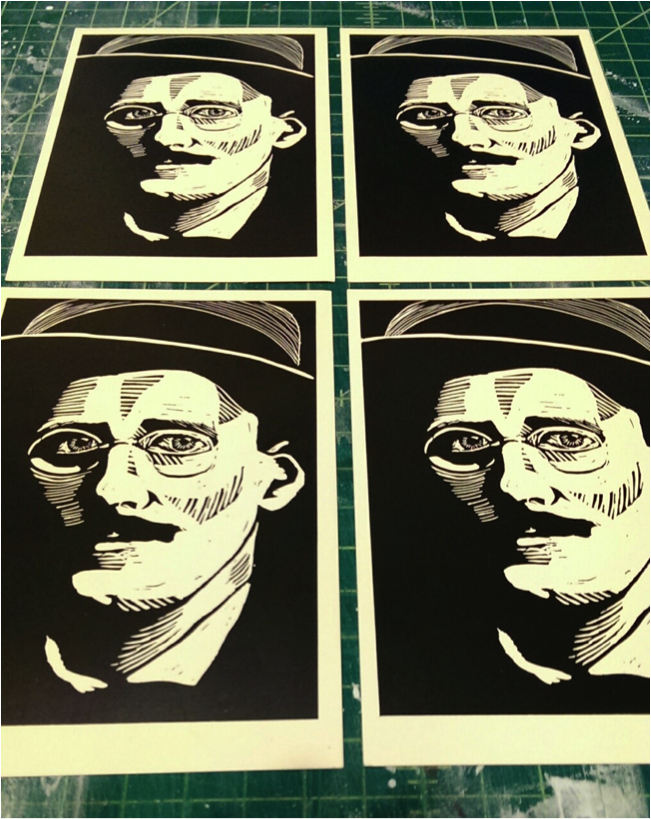 |
| Postcard of James Joyce © by Rachael Romero |
At the time that Rachael did the woodblock print for the
cover of my collection of poetry, she was making her living partly by sketching portraits
of tourists on 6th Avenue in Greenwich Village in New York City,
usually on warm summer nights. When I wanted to discuss the project with her, I
stood next to Rachael on the sidewalk as she created quick and insightful pastels
of passerby who would stop to have their likenesses done.
 |
| Portraits © by Rachael Romero |
This brings up another point about collaborations—you inevitably have to go outside your comfort zone in working with another artist. You might find yourself discussing your project standing on a corner under a streetlamp at ten o'clock at night.
I once remarked to Rachael Romero that her work greatly resembled some of the political posters that I liked from the 1960s and 70s, artwork produced by a group that signed itself the San Francisco Poster Brigade. “I was the San Francisco Poster Brigade,” Rachael confided, not without a touch of pride.
I once remarked to Rachael Romero that her work greatly resembled some of the political posters that I liked from the 1960s and 70s, artwork produced by a group that signed itself the San Francisco Poster Brigade. “I was the San Francisco Poster Brigade,” Rachael confided, not without a touch of pride.
 |
| Poster © by Rachael Romero as the San Francisco Poster Brigade |
The style of Rachael’s that evokes the period of the Works Progress Administration (WPA) of the 1930s—I love it!
Another artist I admired enormously whose work is on the cover
of one of my books of poetry is Mona Caron. Mona is an amazing and accomplished
mural painter whose artwork graces many buildings internationally, including
the bikeway mural on the Safeway supermarket at the busy intersection
of Market Street and Duboce Street in San Francisco.
 |
| Duboce Bikeway Mural © Mona Caron |
I met Mona Caron at the dedication ceremony for one of her
murals. Whenever I wanted to discuss our collaborative project, I had to find her at the site of the mural she was painting at the time and shout up to her while she was high on a scaffold above the street.
 |
| Mona Caron painting |
Mona did a fabulous cover for my book of love poems, The Number Before Infinity. We had multiple discussions about the artwork. Mona was concerned that in portraying a sensual woman, she might be
objectifying the person in the image. I think she found a way to evoke the
eroticism of the love poems in the book while still depicting the female
figure as powerful.

Interestingly, Mona elected to handwrite the type on the cover in black letters, in order to have it match the wind-swept hair of the woman in the illustration.
I’ve found these collaborations with visual artists so fascinating.
I’ve gotten to work with painters and graphic artists whose work I was a huge
fan of, and felt a deep affinity for. To see their work displayed in tandem
with my own is humbling and gratifying. Their artwork and interpretations of
the poems add greatly to the reader’s experience.
Writers and Collaboration, Part 2, Part 3, Part 4
Writers and Collaboration, Part 2, Part 3, Part 4
Zack’s most recent book of poems, Irreverent Litanies
Zack’s most recent translation, Bérénice 1934–44: An Actress in Occupied Paris by Isabelle Stibbe
Other recent posts about writing topics:
How to Get Published
Getting the Most from Your Writing Workshop
How Not to Become a Literary Dropout
Putting Together a Book Manuscript
Working with a Writing Mentor
How to Deliver Your Message
Does the Muse Have a Cell Phone?
Why Write Poetry?
Poetic Forms: Introduction; The Sonnet, The Sestina, The Ghazal, The Tanka, The Villanelle
Praise and Lament
How to Be an American Writer
Writers and Collaboration
Types of Closure in Poetry


