Showing posts with label haiku. Show all posts

Sunday, July 3, 2022

Haiku in Africa: An Interview with Adjei Agyei-Baah

This blog features an interview with Ghanaian poet Adjei Agyei-Baah, one of the leading writers of “Afriku,” the school of haiku poetry flourishing in Africa. Agyei-Baah is the author of three volumes of haiku: his latest, Scaring Crow (Buttonhook Press); Afriku (Red Moon Press); and Ghana 21 Haiku (Mamba Africa Press). He is the cofounder of the Africa Haiku Network (AHN) and coedits Mamba Journal, Africa’s first haiku magazine.

Adjei Agyei-Baah

Could you talk a little bit about the history of haiku writing in Africa?

Haiku writing in Africa owes a lot to Sono Uchida, the prominent Japanese haiku poet and diplomat, who thirty years ago in Senegal initiated a haiku contest in the French language. That was the first international haiku competition in Africa.


During his mission as a Japanese ambassador in Africa, Uchida always felt that Senegal would be a fertile ground for the growth of haiku. The way the Senegalese people adapted to nature reminded him of the traditional world of the Japanese people, a way of life that was rapidly disappearing. According to Sono Uchida, it was the belief of haiku poets in Japan that nature does not belong to humanity, but rather it is humans who belong to nature.


Uchida’s promotion of haiku in Senegal was supported by the first President of Senegal, His Excellency Léopold Sédar Senghor, who was also a great friend of haiku.


In more recent years, haiku has spread particularly in West Africa, especially in Ghana and Nigeria. Some African haiku writers have pushed the genre in new directions. Emmanuel-Abdalmasih Samson of Nigeria, for example, invented what he termed “mirror haiku,” a technique now used by many other haiku writers around the world. Here’s an example from Samson’s poetry:


        walking in the rain

        umbrellas sing counterpoint

        August concerto


        August concerto

        umbrellas sing counterpoint

        walking in the rain


How did you personally come to haiku as a form for your poetry? Why does haiku particularly appeal to you as a writer?


I got to know haiku through my fellow Ghanaian countryman, Nana Fredua-Agyeman, a very strong haiku contender. He used to share haiku on his blog. I followed his adventures and became addicted to the genre. I was captivated by its feature of brevity and the way a short haiku also says much more. It seemed a good way to tell African stories.


Your new chapbook, Scaring Crow, has a remarkable form—every haiku mentions a scarecrow. What drew you to that image, and what associations does it have for you personally and as an artist?


It's a book I wrote purposely to try to push the frontiers of haiku. Arguably, it's the first haiku collection ever to explore a single theme in more than 100 ways. It was an honour and privilege to have great haiku scholars and doyens like Hiraoko Sato, Professor John Zheng, and Scott Mason contributing the foreword and blurbs.


Do you write in other forms besides haiku, or in free verse? If so, how do you know when a poem wants to be a haiku, and when it needs a different shape?


Yes, I began with longer poems before discovering haiku, and I’ve had several long poems published in international journals and anthologies. As part of my practice, I create a haiku when nature presents a moment in a flash of lightning, that delivers a lasting after-image. But when I want to address humanity, or talk about more scholarly topics, I usually write longer poems.


Any advice for writers who would like to write haiku?


Deep observation yields haiku! To communicate an aha! moment from nature, a novice writer must constantly observe. Read good haiku journals and publications to improve your craft. I hope to see more African poets, both young and experienced, come to the practice of haiku to tell African stories, as few are doing at the moment.


Here are some favorites of mine from Adjei Agyei-Baah’s new chapbook, Scaring Crow:


        All Saints’ Day

        a scarecrow glows

        in fireflies


        gleaning the field

        a hidden melon

        behind the scarecrow


        ripened field

        an old scarecrow invites

        birds to party


        flitting butterfly

        the scarecrow’s shoulder

        provides a rest


        country walk…

        passing on an old hat

        to a scarecrow


        parting mist…

        the open arms

        of a scarecrow

Zack’s most recent book of poems, Irreverent Litanies


Thursday, September 19, 2019

The Influence of East Asian Literature on Western Poetry: Part 4—Jack Kerouac’s Haiku; and Conclusion

The last poet I’m going to talk about is Jack Kerouac, who lived from 1922 to 1969. Kerouac is better known as a fiction writer, and he was the scribe of the Beat Generation. The Beats were a group of writers and artists who burst on the American scene in the city where I live, San Francisco, in 1955.

Beat Generation writers: Jack Kerouac, Allen Ginsberg, William Burroughs 

They were rebels who rejected the materialism of the post-World War II era in the West, and favored dropping out of society to experience authentic life through road trips, jazz clubs, altered consciousness, and amorous adventures. The most famous text of the Beat Generation is Jack Kerouac’s novel On the Road, an account of a car trip through the United States and Mexico.

Manuscript of Jack Kerouac's On the Road

 
Kerouac typed this book on a continuous scroll of paper, unedited. On the surface, this novel is extremely American, but like much in Kerouac’s work, it has East Asian roots.
East Asian literature came to the Beat Generation through a complicated family tree. It’s a lineage that can also be traced back to Judith Gautier’s Le Livre de jade, which was known to the U.S. poet Ezra Pound. Pound created his own anthology of East Asian poetry, which he called Cathay and published in 1915. Cathay was an enormously influential book in the United States, and it profoundly affected the San Francisco poet Kenneth Rexroth, who was the literary mentor of the Beat Generation writers. 

Kenneth Rexroth (1905–1982)

Rexroth created his own anthologies of East Asian writing, which were very popular:
One Hundred Poems from the Japanese, published in 1955, followed the next year by One Hundred Poems from the Chinese; and for good measure, 100 More Poems from the Japanese in 1976, not to mention Orchid Boat: Women Poets of China and The Burning Heart: Women Poets of Japan.
Rexroth’s interest in East Asian poetry also dovetailed with that of Beat Generation writer Gary Snyder, immortalized in The Dharma Bums, Jack Kerouac’s roman à clef. Gary Snyder not only read Chinese and Japanese, he lived in Japan in the late 1950s and early 1960s, and translated the Cold Mountain Poems of T’ang Dynasty poet Han Shan.
For the Beat Generation writers, it seems to me the quality that they were seeking in East Asian literature was spontaneity. Spontaneous action was something that the materialist culture of shopping mall, yes-man America did not favor. The Beat Generation writers admired that belief in inspiration in the moment in East Asian writing, and the related Buddhist practice of remaining conscious of the present, another alternative to 1950s consumerism.
Jack Kerouac’s persona in The Dharma Bums begins writing haiku under the inspiration of the character based on Gary Snyder. Kerouac was also reading the four-volume translation of haiku by R.H. Blythe, simply titled Haiku.

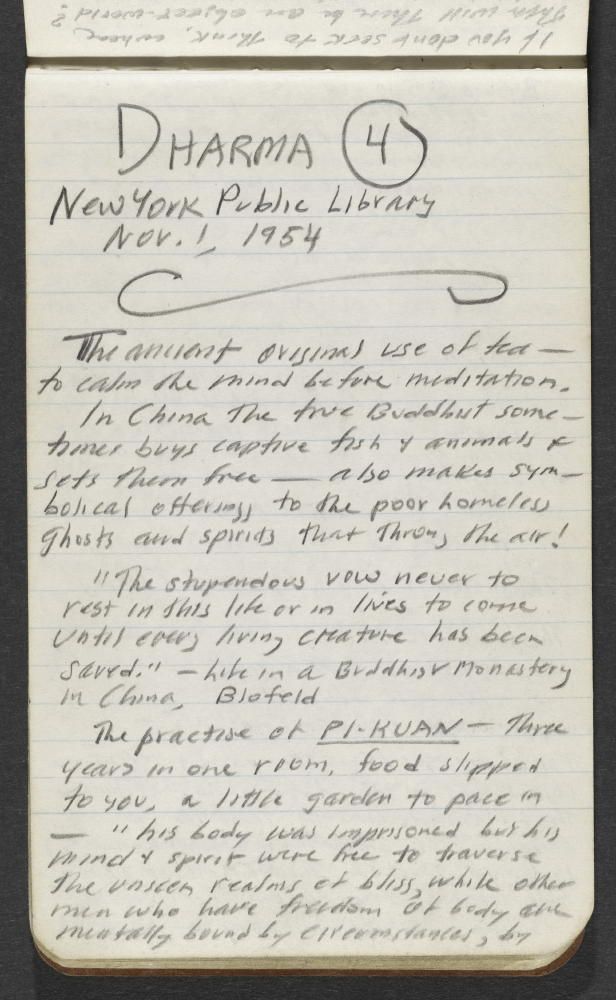
Jack Kerouac's notebook

According to Regina Weinreich in her introduction to Kerouac’s Book of Haikus, Kerouac scribbled haiku in “small bound notebooks—the kind he would press into his checkered lumberman’s shirt pocket and carry around anywhere for fresh and spontaneous entries.” Weinreich also mentions that Kerouac began writing haiku as a kind of literary sketchbook that he carried with him as he wandered the streets of New York and San Francisco and the highways of the United States.
The spontaneity of haiku seemed to Kerouac a perfect match for the improvisations of jazz.

Al Cohn, Jack Kerouac, Zoot Sims

Kerouac recorded a wonderful album of Blues & Haikus with the celebrated jazz saxophonists Zoot Sims and Al Cohn in 1959. You can hear this album on YouTube. Here are a couple of my favorite Kerouac haiku:

Crossing the football field,
     coming home from work
The lonely businessman

In my medicine cabinet
     the winter fly
Has died of old age

            Wash hung out
     by moonlight
—Friday night in May

Empty baseball field
     —A robin,
Hops along the bench

(haiku copyright © by Jack Kerouac)

What strikes me in listening to all of the haiku that Kerouac recorded on this album—just a fraction of the 1000 haiku he penned in his lifetime—is that these poems do not resemble the Kerouac we tend to think of. The Kerouac of the popular imagination, the Kerouac of On the Road, is an ecstatic adventurer. The haiku of his that I found the most emotionally authentic were the ones that recorded moments of quiet pathos. Maybe my own bias is showing here, but it’s interesting that this East Asian form gave Kerouac permission to show a side of himself that doesn’t emerge much in the pumped-up adventures of his novels.

I’ve chosen these three representative poets from three different regions of the West, who were part of different literary schools, and wrote during different time periods. All three of them were deeply influenced by the writing of East Asia. I call these three writers representative because they are just the tip of the wedge. I could have focused on any number of other poets, from many other countries and literary circles. Countless Western poets have borrowed from the literature of China, Japan, and Korea. By discussing these three writers, I’ve tried to show what an enormous debt the poets of the West owe to the writers of East Asia, and what an essential role East Asian poetry played in the development of literary modernism.

The Influence of East Asian Literature on Western Poetry, Part 1, Introduction
The Influence of East Asian Literature on Western Poetry: Part 3—Less Is More and the Poetry of Jean Follain

Zack’s most recent book of poems, Irreverent Litanies
Zack’s most recent translation, Bérénice 1934–44: An Actress in Occupied Paris by Isabelle Stibbe

Other recent posts on writing topics:

How to Get Published

Getting the Most from Your Writing Workshop
How Not to Become a Literary Dropout
Putting Together a Book Manuscript
Working with a Writing Mentor
How to Deliver Your Message
Does the Muse Have a Cell Phone?
Why Write Poetry? 
Poetic Forms: IntroductionThe SonnetThe SestinaThe GhazalThe TankaThe Villanelle
Praise and Lament
How to Be an American Writer
Writers and Collaboration
Types of Closure in Poetry

Thursday, December 31, 2015

Pathos: What It Is, and How Writers Evoke It

Pathos is one of the emotions writers most frequently evoke in their work. The noun pathos comes from ancient Greek and from the verb πάσχειν, or pas-thein, which means “to suffer.” The Oxford English Dictionary defines pathos as, “A quality which evokes pity, sadness, or tenderness…”

To me, pathos is a personal suffering, a solitary emotion, which is what makes it so poignant. Paradoxically, it is that individual, interior quality of pathos that allows us to empathize with it, since we’ve all experienced moments of pathos.

Unlike other emotions, such as love, hate, anger, outrage, friendship, etc., pathos only requires one person to experience its story. Because it mostly involves the fate of an individual, pathos might be the easiest emotion to invoke, so it’s a good place to start for a beginning writer.

One of the most classic examples of pathos for me is this poem by the great haiku writer, Hattori Ransetsu (1654–1707).

Hattori Ransetsu
Here is the haiku:

The childless woman,
How tender she is
To the dolls!

translated by R.H. Blyth

In this poem Ransetsu tells the story of one person’s life in fewer than twenty syllables. The woman, who is probably a shopkeeper, is arranging dolls, stroking their hair, neatening their clothes. Her tenderness toward them shows the reader the love she would have given her children, if she had them. This one scene, which the poet depicts with a few quick brushstrokes, gives us an entire narrative, an entire life. This is not a woman who has voluntarily chosen to forego having children. The pathos comes from the sense of loss, the absence of the life that this woman would have enjoyed as a mother, and the poignancy of her showing that love to a lifeless doll.

Even though pathos does not require many characters to trigger it, it’s still a tricky emotion to create. The danger in attempting to evoke pathos is sentimentality. Imagine, for example, if Ransetsu had written instead:

That poor, lonely, childless woman—
Isn’t it terribly sad how she tenderly strokes
and soothes the dolls!

If Ransetsu had written this overblown version, we’d sprint from the writer’s blatant appeal to our sympathy. It’s the restraint that Ransetsu exercises in understating the emotion that allows the reader to experience the feeling.

That’s something to keep in mind in trying to create pathos. Pathos is like mercury. It’s fluid. Unpredictable. It arrives in a sudden flash. Trying to force it to appear just doesn’t work. The writer has to create an authentic situation, and allow the pathos to flow into it, and once it does—capture it and snap the lid shut so it doesn't get away.


Monday, October 1, 2012

How Not to Become a Literary Dropout, Part 5

In Buddhism there is a term “right livelihood,” which refers to making a living in a way that is in harmony with your spiritual principles. As a writer, you also need a “right livelihood,” one that is in harmony with the demands of being a writer. Or, you can marry someone rich with a cute English accent, not a bad alternative. That works, provided you remain in touch with something you are passionate about.
Barring that, pick a career and a lifestyle that allows you time for your writing. Writing is a time-consuming activity. Even if you’re writing haiku—especially if you’re writing haiku—you need mental time to process your writing. I think of our creative thought processes as working like laundromat dryers, where you watch the clothes going round and round, in endless combinations.


You need your thoughts to circulate like that, for the shirts to get tangled up in the sheets and the pants in the shirts, in order for the right creative combination to occur. Make time to go walking or jogging or skiing or swimming, where all you do is think and compose in your head. Allow new thoughts and word combinations to mix in with your brain waves.
The English Romantic poets William Wordsworth and Samuel Taylor Coleridge used to compose their poems while hiking. 

                                                           William Wordsworth

                                                        Samuel Taylor Coleridge

Wordsworth and Coleridge did this first on England’s southern coast, and later in the Lake District. They took so many walks along the coast that faced France, and their writings were so radical, that the English government suspected they were plotting to find a landing site for the troops of the French Revolution to invade England. So the government assigned a spy to follow Wordsworth and Coleridge on their hikes, just in case. All the spy got to witness was a few sonnets in the making, but I wonder what that spy was thinking when he followed the poets on their romps through the rainy countryside of England. “Kubla Khan—hmm. That must be some kind of code.” “What do the daffodils stand for: maybe Robespierre?”
One thing you can do to sustain your career as a writer is to choose a type of work that allows you time to think about writing, and to write. That doesn’t mean you need a job where you can sit and type sestinas all day at your computer, though few of us would complain about being paid for writing poetry. But there are some careers that feed your writing, and others that starve it. A career that feeds your writing is not necessarily teaching writing or literature. Wallace Stevens was a lawyer on the payroll of an insurance company, which in those days, was a relatively low-pressure job, I imagine. Gary Snyder worked as a watchman on a fire tower for the Park Service and wrote many terrific poems while he did that. Th poet May Swenson had jobs as a stenographer and secretary for decades while she wrote most of her best poems. For years the poet Li-Young Lee worked as a clerk in a book warehouse, but the job allowed him the privacy and mental space he needed to develop as a writer. I’m not suggesting you get a dead-end job—you should have a career that fulfills you professionally.
But some careers do make it almost impossible to write. I doubt you can be in charge of a major business or nonprofit organization or a major part of a business or organization, where you have to supervise many employees, and still write actively. I don’t think you can be in a corporate law firm where there’s pressure to make partner. It’s the mental time as well as the actual writing time that suffers in that sort of job. I’ve never known a writer who had a job like that. For one thing, they’d never hire us, and rightly so. But I’d be happy to be proved wrong about this, if someone knows a counter-example.
If you don’t know if a job will allow you the mental and physical time to write, try it out. You’ll find out soon enough.
Use your time wisely, as our seventh grade teachers used to tell us. People who get hooked on watching multiple old TV series all the time may have fun with that hobby, but they rarely finish writing books.
Another important method for saving time for your literary work is to think through an idea before you start writing it, the way a chess master looks many moves ahead before pushing even a pawn one space forward. Play out the possible combinations, to see if you have any place to go with that idea. If you see that the moves you plan will lead to an insurmountable problem, try a different idea later. That will save you time.

Other recent posts about writing topics: