Showing posts with label Associated Writers and Writing Programs. Show all posts

Saturday, March 5, 2022

How Much Should You Know Before You Start Writing

When a piece of writing involves research, you might ask yourself when you’re ready to start writing. You want to have enough background information that you can recreate the world you are studying truly. You also want to know enough that you can identify with the subject you’re writing about, and maybe even gain some insight into those lives.

Let’s say you’re writing a short story or a poem that features the wonderful painter, Mary Cassatt. You should read at a very minimum the Wikipedia article on Cassatt. You might even read a really scholarly biography about the artist to pick out a detail here or there that will give your story the ring of authenticity. Here’s an example: it’s interesting that Cassatt, a woman artist, was good friends with Edgar Degas, a notorious misogynist.
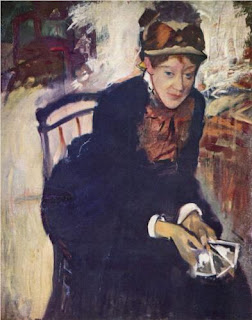
Portrait of Mary Cassatt by Edgar Degas
The two of them sometimes even painted side-by-side. Imagine the great conversations! Think of their differing interactions with a model. If you were writing a full-length work about Mary Cassatt, a novel or a play based on her life, I would think you’d want to read multiple biographies in order to feel you were almost a Cassatt expert.

But is it possible to research a subject too much before you start writing about it? I listened to a fascinating panel on historical plays at a conference of the Associated Writers and Writing Programs (AWP) several years ago. One of the panelists, Deborah Brevoort, had been commissioned to write a play about Martha Washington, the wife of George Washington. In researching her topic before she started writing, Brevoort discovered that Martha Washington kept up a lively and extensive correspondence with her husband. Perfect material for a play, right? Unfortunately, after George Washington died, Martha burned all their letters. What a disaster! What surprised me was Brevoort’s reaction to learning this. She was actually overjoyed. I was flummoxed, till I heard her next comment: “That meant I could make it up!”
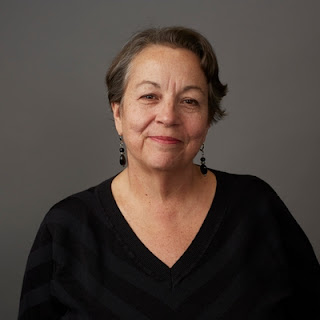
Deborah Brevoort

When I thought about that, it made a lot of sense. In order to really get inside the experience of Martha Washington, the playwright had to find deep connections between the first First Lady’s life and her own. That’s not so easy if you have so many specific facts in your head that you can’t bend your subject’s story closer to your own. To make that play work emotionally, the playwright had to make herself into Martha Washington, and Martha Washington into her, to some degree, so she could write about that other life with real understanding and empathy. And that becomes almost impossible, if at the same time, you’re juggling countless historical facts.

So, how much research is enough, and how much is too much? You’ve done too much research if the knowledge you’ve accumulated becomes so detailed and specific that it impedes your personal identification with your topic and prevents you from writing. You haven’t done enough research if you still need more details and situations to create content that is believable and compelling both to you and your audience.

Zack’s most recent book of poems, Irreverent Litanies

Zack’s most recent book of translations, Bérenice 1934–44: An Actress in Occupied Paris

Other posts of interest:

How to Get Published

Getting the Most from Your Writing Workshop

How Not to Become a Literary Dropout

Putting Together a Book Manuscript

Working with a Writing Mentor

How to Deliver Your Message

Does the Muse Have a Cell Phone?

Why Write Poetry?

Poetic Forms: Introductionthe Sonnetthe Sestinathe Ghazalthe Tankathe Villanelle

Praise and Lament

How to Be an American Writer

Writers and Collaboration

Types of Closure in Poetry

Saturday, May 26, 2018

“Pay-to-Play” Now on the Increase in the Arts

The marketing world has long been familiar with the “pay-to-play” style of doing business. There are many websites and publications where articles are published or institutions are listed in rankings only when money changes hands. For instance, many magazines that cover issues of interest to lawyers charge contributors hundreds of dollars to publish an article, since authors displaying their expertise is a form of advertising their services to potential clients.

In the art world, people don’t like to talk about the growth of “pay-to-play.” Spending money to have your work reach the public smacks of self-promotion and vanity. But increasingly, and quietly, arts organizations are charging artists to present their work. Many literary publishers are asking writers to buy a certain number of books in order to cover their costs; more and more literary magazines, presses, and contests are charging ever-larger fees for submissions; many theaters are requiring playwrights and performers to pay for expenses such as space rental, tech services, and marketing; and some galleries are charging artists to show their work.

I don’t blame arts organizations for passing some costs along to artists. It’s not as if nonprofit theaters, publishers, and galleries are raking in big bucks that they’re hiding from artists. The arts organizations are under enormous financial pressures that have forced them to adopt the “pay-to-play” model, often against their own inclinations. I do think it’s worth discussing the “pay-to-play” phenomenon in the arts, though, because it has implications for whose work is presented, and how and when artists attempt to reach the public.

There was a time in the not-so-distant past when the arts were often supported by wealthy patrons. I recently visited the Peggy Guggenheim Collection in Venice, for example, and was reminded that Peggy Guggenheim supported a number of artists and writers in the mid-twentieth century, including the painter Jackson Pollock and the writer Djuna Barnes

Peggy Guggenheim
If you read the letters of the poet Rainer Maria Rilke, you can see that he diligently corresponded with his numerous patrons, updating them on his artistic progress and requesting funds or places to work.

One cause of the current “pay-to-play” situation may be the increasing number of artists competing for funds and a public. For example, the annual conference of the Association of Writers & Writing Programs in North America began in 1972 with a couple of hundred attendees. The most recent conferences have all averaged well above 10,000 attendees. With so many artists vying for attention and venues to present their work, arts organizations have also proliferated. The funding sources for these organizations have not kept pace, and government support for the arts in the United States, for one, has declined or remained mostly flat for many years.

Another reason that arts organizations are asking artists for support is that the wealthiest philanthropists currently are finding other outlets for their gifts. In the San Francisco Bay Area, where I live, for instance, we have recently seen a wave of hospital construction and rebuilding, including the stunning Lucile Packard Children’s Hospital in Palo Alto; and UCSF Benioff Children’s Hospital and the Zuckerberg San Francisco General Hospital renovation, both in San Francisco. Those are wonderful additions to our communities, and my own family has benefited from the fantastic care at one of these institutions. But where is the tech philanthropist who is going to support independent theaters or literary publishing? You don’t have to be in the arts to fund the arts. The Guggenheims didn’t make their fortune as surrealist painters, but Peggy Guggenheim helped surrealist painters by buying their work.

The downside of the current regimen in the arts is that many artists can’t afford to “pay-to-play.” Their work is at risk of being lost in today's art economy. Even those who can occasionally afford to fund-raise and use personal resources to launch a project in the arts may find that their ability to generate funds through crowdsourcing campaigns is not as great as their creative output, forcing them to limit the number and ambition of their projects.


I would like to see more discussion of “pay-to-play” in the arts, not to point fingers at nonprofit arts organizations, but to explore the implications of this phenomenon and to try to brainstorm alternatives.


Zack’s most recent book of poems, Irreverent Litanies
Zack’s most recent translation, Bérénice 1934–44: An Actress in Occupied Paris by Isabelle Stibbe

How to Get Published

Getting the Most from Your Writing Workshop
How Not to Become a Literary Dropout
Putting Together a Book Manuscript
Working with a Writing Mentor
How to Deliver Your Message
Does the Muse Have a Cell Phone?
Why Write Poetry? 
Poetic Forms: IntroductionThe SonnetThe SestinaThe GhazalThe TankaThe Villanelle
Praise and Lament
How to Be an American Writer
Writers and Collaboration
Types of Closure in Poetry

Saturday, February 1, 2014

AWP Seattle 2014: A Preview

New this year at the conference of the Associated Writers and Writing Programs (AWP) is a full schedule of events on Saturday. In the past, Saturdays at AWP have mostly been for winding down, packing up, and saying goodbye to friends. No more. This year, Saturday is jammed with events, including readings in the evening by poets Sharon Olds and Jane Hirshfield, as well as by prose writers Sherman Alexie and Timothy Egan. If you haven’t already made your travel plans, try to stay at least till Sunday morning, so you can catch all the Saturday activity.

AWP is rightfully proud of this year’s line-up. According to AWP Director of Conferences Christian Teresi, “I’m really excited about the programming this year. I think this is arguably the best overall slate of events we’ve ever had.”

AWP has also added a number of services to make things easier for conference attendees. There are maps of the venues, bookfair, and downtown Seattle on the main conference webpage: https://www.awpwriter.org/awp_conference/overview

“Attendees are also now able to personalize the online schedule,” Teresi notes. Instructions can be found on the main schedule page: https://www.awpwriter.org/awp_conference/schedule_overview

This year, registration will not be closing between the end of preregistration and onsite registration. There is a new will-call registration system that hopefully will bypass the long lines. “As always, we encourage attendees who have not registered to do so now, as using the will-call system will be faster than registering onsite,” adds Teresi. 

Some of my favorite writers will be attending AWP. Each day of the conference I’ll be posting highlights that I find interesting. Look for events with these writers:

Kim Addonizio
Anita Amirrezvani
Richard Blanco
Catherine Brady
Mark Doty
Cornelius Eady
Nick Flynn
Thaisa Frank
Robert Hass
Ernestine Hayes
Tyehimba Jess
Charles Johnson
Phillip Lopate
Nancy Lord
Bobbie Ann Mason
C.M. Mayo
Robert Pinsky
Eva Saulitis
Patricia Smith
Gary Snyder
Carla Trujillo
David Wojahn
Sholeh Wolpe
Matthew Zapruder


“Seattle is a great city with great facilities, and we’re really looking forward to hosting the conference there,” Teresi sums up.

Other posts on the AWP conference:

Zack Rogow will be chairing two panels at the AWP conference in Seattle on Thursday, February 27: Is Poetry Ready for Prime Time? with Cornelius EadyKim Addonizio, and Toby Barlow, from 10:30 to 11:45 a.m.; and Homesteading on the Digital Frontier: Writers' Blogswith Mark Doty, C.M. Mayo, and Charles Johnson, from 4:30 to 5:45 p.m.

Other recent posts about writing topics: 
How to Get Published: Part 1Part 2Part 3Part 4 
Getting the Most from Your Writing Workshop: Part 1Part 2Part 3Part 4Part 5Part 6Part 7
How Not to Become a Literary Dropout, Part 1Part 2Part 3Part 4Part 5Part 6Part 7Part 8Part 9Part 10
Putting Together a Book Manuscript, Part 1Part 2Part 3Part 4Part 5Part 6Part 7
Working with a Writing Mentor: Part 1Part 2Part 3Part 4Part 5
Does the Muse Have a Cell Phone?: Part 1Part 2Part 3Part 4Part 5
How to Deliver Your Message: Part 1Part 2, Part 3Part 4Part 5Part 6
Why Write Poetry? Part 1Part 2Part 3Part 4
Using Poetic Forms, Part 1: Introduction; Part 2: The Sonnet; Part 3, The Sestina;
Part 4, The Ghazal; Part 5, The Tanka

Monday, February 6, 2012

Tips for the AWP Conference, Part 2: Don't Avoid the Book Fair

Many people who attend the annual conference of the Associated Writers and Writing Programs (AWP) avoid the book fair. It’s true the book fair can be completely paralyzing, with its hundreds of booths and thousands of attendees all schmoozing as if their lives depended on it. Don’t miss the book fair, though. It’s the best opportunity all year to make contact with editors and with organizations for literary writers.

But when you visit the book fair, go with a specific purpose in mind.

Let’s say you’ve got several stories or poems you feel are ready to send out. Ignore the booths of presses that only publish graphic novels about surfing vampires. Focus on talking to presses that have a magazine that’s looking for new work, but don’t miss the fun of just a random conversation.

Bring a business card. If you don't have a business card for your work as a writer, just print it on a laser printer onto card stock.

Make contact with editors who might appreciate your work. Leave a card with them and say something positive about what you sincerely admire about their publication. If you can afford it, buy one of their books or magazines. Ask for the card of the editor you want to send work to, make notes on the back of the card about what you discussed. Email or write to that person directly when you follow up. Don't make contact until several days after the conference, not during the conference. Don’t give out anything other than your card during AWP. The people at the tables are under siege. Be considerate. When you write to them later, just remind the editor that you met at AWP.

The same idea applies if you have a manuscript to send out. Find out which presses are open to new work in your genre and in your style, and get a business card of a person to send a manuscript to. Follow up with every place where you have a good contact, but after the conference.

If you have a book to publicize, look for reading series and publications that review work in the same vein as your book.

Besides all the schmoozing, make sure to take in at least two great readings at the conference, and two panels that make you rethink what literature can mean. Invite someone to lunch you didn’t know before the conference. And leave time to enjoy and explore the city of the bookfair and/or its surroundings.


Thursday, February 2, 2012

Tips for the AWP Conference, Part 1

The annual conference of the Associated Writers and Writing Programs (AWP) is an amazing event that brings together many thousands of writers, publishers, and creative writing instructors in one place for four days. It’s the largest gathering of its kind in North America. 

The AWP conference has an interesting history. According to Christian Teresi, AWP’s former director of conferences, “The first conference was in 1972 at the Library of Congress, and hosted only six events. It’s safe to say there were at most a couple of hundred people there.” Growth was slow during the early years. “I can tell you that at the 1991 conference in Miami there were only around 16 events and 40 presenters,” Teresi recounted. Since then, the increase in the number of participants and programs has been nothing short of astronomical. “By 2012 we already had over 400 events and 1600 presenters.”

The AWP conference is now as over-stimulating as seven marching bands all doing their routines at once on the same football field. You get to hear great or disappointing readings by writers you admire, have chance encounters in glass elevators with people you never wanted to see again, discover writers you’re delighted to learn about, get headaches, wolf down overpriced food, buy more books than you planned, make embarrassing faux pas, and maybe reach a few people with your work who didn’t know your writing beforehand.

Is it worth it? Absolutely. It’s a unique and amazing opportunity to have that many literary people and institutions in one place at one time. You get to hear some of your literary heroes. You have the chance to meet the editors of your favorite magazines and presses, and to find out about ones you never knew existed.

But I find that it’s much more productive to go to AWP if you have a clear goal in mind.

Think about what your current needs are as a writer. Do you have several pieces you’re ready to send to magazines? Have you got a manuscript for a new book that you’re hoping to find a publisher for? Do you have a new book just published that you want to publicize? Are you looking for a job or internship with a literary organization? Do you want to get re-energized to go home and write? Pick a goal and stick to it.
_________________________________
Zack’s new book of poetry, The Kama Sutra for Senior Citizens and Other Poems on Aging. Order in the USA    Order in the UK
Other posts of interest:

How to Get Published

Getting the Most from Your Writing Workshop

How Not to Become a Literary Dropout

Putting Together a Book Manuscript

Working with a Writing Mentor

How to Deliver Your Message

Does the Muse Have a Cell Phone?

Why Write Poetry?

Poetic FormsIntroductionthe Sonnetthe Sestinathe Ghazalthe Tankathe Villanelle

Praise and Lament

How to Be an American Writer

Writers and Collaboration

Types of Closure in Poetry