This blog provides advice to writers on their literary work.
See the end of this post for links on these topics: How can you get the full benefit of workshops? How can you work best with your mentor? What, when, and how should you publish?
Let’s face it, books are a
problem. They smell funny when they age, like old people. They take up too much
space, and you have to keep buying shelves for them. Books are electromagnets for
dust, and you can’t even throw them in the wash.
When you move,
books are a nuisance to take with you. You have to go all around the
neighborhood rounding up cartons for them, which turn out to be too heavy to
lift once you’ve packed them. Then you have to haul them upstairs. After all
that, you know you’ll never read them. They’re just decoration. Is it really
worth it?
If they’re
library books, you have to remember to bring them back on time, or you wind up
accumulating such large fines that you could have bought the book twice over.
When you come
right down to it, most books are depressing, if not outright morbid. Especially
the so-called “classics.” When you buy a book, you’re paying good money to give
yourself the blues. Treat yourself to a spa instead, get a facial, go out to
the latest restaurant, or splurge on a pair of shoes you won’t wear everyday.
You’ll be a happier person.
Maybe
if you could plug them in and recharge them, books would be good for something.
They don’t have buttons to press, they don’t light up or make noises, you have
to keep turning those darn pages, and they don’t look up difficult words in the
dictionary for you. They’re not even searchable. What good are they?
The other problem
with books is that they’re so hard to forget. Now a good sitcom—you’re done
with it and it’s over, like a hot shower. A book stays with you, even when you wish
you could forget it.
Personally,
I don’t think anyone should be allowed to read a book in public. Books distract
from important things, like ads. In essence, books are anti-social. Yeah, books
are a big problem. You never know what people might be thinking when they’re
reading a book.
In rereading the Declaration of
Independence of the United States on the anniversary of its
signing, I’m struck by a phrase I’d forgotten was an important part of the
text. The signers objected to the king of England preventing the naturalization
of immigrants to the thirteen colonies: “he has endeavoured to prevent the
population of these States; for that purpose obstructing the Laws of
Naturalization of foreigners…”
That phrase keeps ringing for me,
“obstructing the Laws of Naturalization of foreigners…” particularly in the
light of Justice Antonin Scalia’s dissenting opinion when the Supreme
Court struck down parts of Arizona’s law on immigration. Scalia attacked
President Obama’s executive order of June 15, 2012, blocking the deportation of approximately 800,000 young
people who came to this country as children, who are not yet naturalized
citizens. Isn’t Justice Scalia doing exactly what the founders of our republic
criticized the British monarch for, “obstructing the Laws of Naturalization of
foreigners”?
If there are people living within
the borders of the United States of America, working hard in our
economy, raising their children here, shouldn’t they and their children have
the right to become citizens of this country? Why should those people, who are
active members of our society, live in daily fear of deportation?
Former Republican presidential candidate
Mitt Romney has said of the young people who grew up here who are not yet
citizens, that they should “return home, apply and get in line with everyone
else.” But this country is their home.
Let’s join with the founders of our
country in extending a welcome embrace to those who are living in the United
States and wish to become patriotic Americans. Don’t we still “hold these
truths to be self-evident, that all men are created equal, that they are
endowed by their Creator with certain inalienable Rights”?
Several years ago I read Stephen Hawking’s brilliant book, A Brief History of Time, and marveled at his ability to make the Theory of Relativity exciting to troglodytes like me who never braved
a science course after high school. Hawking discusses how Relativity shows that time is actually subjective, based on the observer’s relation to gravity.
But he then asserts that time is an arrow,
always moving in one direction:
“Our subjective sense of the direction of time, the psychological arrow of
time, is therefore determined within our brain by the thermodynamic arrow of
time.”
I think writers operate with an
entirely different notion of time. Our idea of time is based more on emotion. In Einstein’s
vision of space, the shortest distance between Point A and Point B is not a
straight line as it appears on a ruler, but a line tugged and stretched by the
gravity of nearby bodies. So the time between Moment A and Moment B is, for the
writer, not a simple stopwatch calculation. For the writer, the proximity of an
event in time has more to do with its emotional and symbolic power for the
person affected by it. The day of my mother’s death, for instance, though it
occurred over forty years ago, is far closer to me and easier to recall
than the work meetings I attended last week. My first day of kindergarten
fifty-five years ago is more vivid to me than my commute this past Thursday.
For the writer, the nearness of
the past has more to do with its emotional and symbolic mass than with its
place in the linear parade of time. But this applies not only to the
past, but to the future. Just as past events constantly erupt in our present
consciousness, events from the future that have a traumatic or symbolic power
seem to ripple into the present. This happens most often in our dreams, where
we are most sensitive to the curvature of time, but it also sprouts up in
our waking life. How many times has each of us dreamed some detail only to
see it occur a few hours later the next day? Of course we all shrug off all such
events as coincidence. But let’s not forget that for centuries scientists
dismissed the slight miscalculations that Newtonian physics produced, before the
Theory of Relativity revealed that this margin of error pushed open the door to
understanding the nature of space.
For the writer,
the curvature of time has always been of the utmost importance. Tragedy as a
literary genre is obsessed with foretelling the hero’s future fall.
Think of the Weird Sisters’ prediction that Macbeth will meet his doom when
Birnam Wood comes to Dunsinane and at the hand of a man “not of woman born.”
The mechanics of how this prophecy plays out are a huge part of what makes
Macbeth’s fate interesting, not the fact that he died after a
certain string of events. In Ford Maddox Ford’s novel The Good Soldier, the story is told out of sequence altogether, the
jumbled way one person would actually recount it to another, in a burst dam of
emotions. Wordsworth’s daffodils and Proust’s madeleine are those writers’
proofs of the formula that the nearness of the past is proportional to its
emotional or symbolic mass.
So I have to quibble with the
physicists’ idea that time is an arrow. As a writer, I see time as being just
as oxbowed as space, with emotion and symbolic gravity as the equivalent of the
physical force of gravity in stretching the elastic of temporal material.
Remember when painters went to
great lengths to hide their brushstrokes? Think of the Flemish masters of the mid
1400s, just at the break of the Renaissance. Roger van der Weyden sat bending
over the blood-gold head of the Virgin and the angel, using such minute strokes
that he had to have a brush with only one hair, so the tool mirrored the image it created. Everything was in the sharpest focus—the
pearl-studded brocade of the angel’s robe, the pattern of nails in the wooden
window shutters in the background, the distant landscape outside—the way it might appear in the
mind of God. The days of the guilds, before the annunciation of the Great
Change.
Then Rembrandt upended it, and
brushstrokes were no longer shamefully hidden but lavished on the canvas.
Even pallet knives, once for mixing colors, were boldly used to scrape light
across the surface of the painting, the artist no longer effacing himself with
each stroke, but proud of his role in producing the image of the tomato-cheeked
burgher. Rembrandt, too, was well worth portraiting, with his global nose that
the light loved; the generous, orange lips; and the dark eyes tunneling back.
And later the hummingbird moment
when paint and image hovered together, the prismatic brushstrokes of the
Impressionists in balance with their subjects, the brush caressing the
light. As in Renoir’s The Luncheon of the
Boating Party:
The painter smoothed
all the figures in yellow straw hats and blue dresses flirting or musing or
lounging after their meal as if the strokes were of the softest hairbrush,
fracturing the air into colors that included all possibilities and beauty in
that one moment as delicious as the grapes and wine left on the table
shielded by the white cloth.
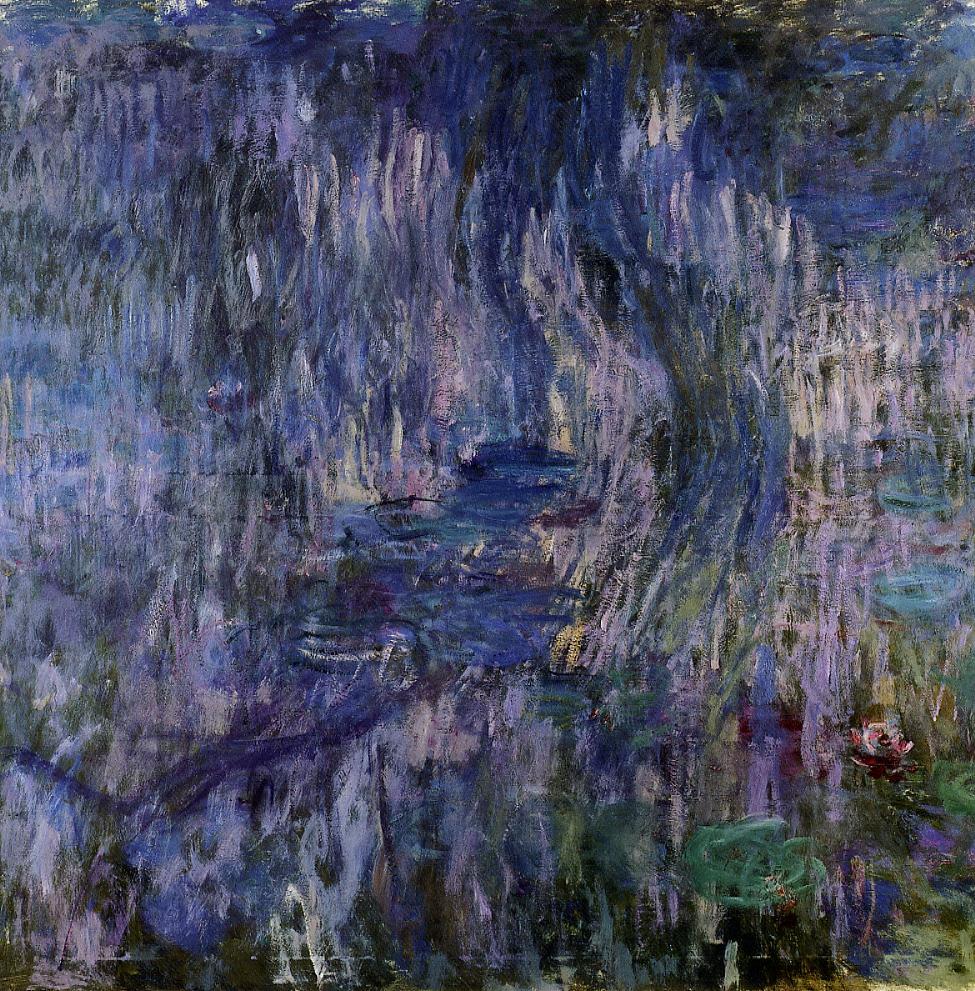
But with Monet’s final
waterlilies the brushstrokes began to revolt, to assert their own importance,
almost eclipsing those liquid-dwelling flowers. The strokes were no longer
content to portray the painter’s moonbridge, they jittered in and around the
rails and the planks, not willing to settle in one place, the way a reflection
is miffed by the wind.
Eventually the brushstrokes took
over the canvas and became the sole subject. Abstract New York Expressionism, Jackson
Pollock’s brush whipping across the surface like a day’s worth of air traffic,
time-lapsed from above. Or like a magnified detail of a painting that is so large it
could never fit in a home.
The circle was now complete. The Process was the
end. And there it was finally, the heart of the artist itself, not a valentine
chocolate box, but a visceral, beating organ with the blue veins and glossy
membranes laid bare.
The poet Kip Zegers and I were watching a mutual friend read poems, back when I lived in Park
Slope, Brooklyn. The friend was reading a series of confessional poems about difficult times in his life. It was
difficult to hear that much pain in one sitting. And then the poet interrupted
the sequence to insert a light-hearted poem that had the audience laughing. You
could feel a palpable sigh of relief among those in attendance, a physical
reaction of comfort.
Kip leaned over
and said to me, “Audiences need to laugh.”
I’ll never forget
that, because at that moment I witnessed firsthand the way that listeners or
readers relax and concentrate again when humor enters into a serious piece of
writing.
It’s as if you’re
at a party and a person you’ve just met starts telling you a story about something
awful, like satanic cults torturing canaries. You might start to
wonder if the individual recounting the story is a bit nutty, since he or she
is telling you something so intense and upsetting without much introduction or warning.
If that person inserts a humorous remark, though, suddenly the whole dynamic
changes. You realize that even though this is a serious story, the person
telling it still has perspective, and that the storyteller does not expect you
to burst into tears before you fish your next beer out of the cooler, or snarf a Dorito
from the bowl on the coffee table.
I’m not suggesting
that Hamlet should be revised to
include knock-knock jokes. But there is broad humor even in Hamlet, in the gravediggers’ scene, for
instance (Act V, Scene 1, for those keeping score at home). The gravediggers
are arguing about a terribly serious subject—whether suicide is a sin, in
response to Ophelia’s death. One of them says, “if
the man go to this water, and drown himself, it is, will he, nill he, he goes—mark you that;
but if the water come to him and drown him, he drowns not himself.”
Pretty silly stuff, to argue that water would come along and drown someone, but
Shakespeare knew that sort of wacky comedy was necessary to hold an audience if
he wanted to prepare them for the deeply tragic ending of Hamlet.
Humor has to be
spontaneous for it to work, but you can leave space for humor to enter your
writing. The more serious the project, the more important it is for
light-hearted landings that allow us a literal breather before we climb the
next flight.
Just as tragedy
needs humor, humor also needs pathos. If you’re writing a comic piece, full of
laughs, it’s crucial for it to have an edge of seriousness. That’s what makes
it art, and not just a TV sitcom. For instance, Billy Collins has that
hilarious poem “Forgetfulness” about not remembering details of favorite books and other names. It’s a
wonderful send-up of the way we lose information as we age:
…one
by one, the memories you used to harbor
decided to retire to the southern hemisphere of the brain,
to a little fishing village where there are no phones.
Lots of great
one-liners in this poem, but at the end, Billy Collins veers toward pathos:
No
wonder the moon in the window seems to have drifted
out of a love poem that you used to know by heart.
The poet reminds how
funny it is that we forget all these details, but the poem is also achingly
poignant, because we see that we are also losing everything that matters to us
as we age and move toward death.
Humor
and pathos are yin and yang. One can’t exist to its
fullest extent without the other. The greatest writers are the ones who know
how to weave the two, tastefully and artfully.
On what note do you end a book of
poetry, fiction, or creative nonfiction? With a crescendo, like a classical
symphony? One famous example of that is the final chapter of James Joyce’s Ulysses, where Molly Bloom’s soliloquy
goes on in an eight-page, nonstop sentence and ends in breathless affirmations.
Or do you finish with a quiet image
that lingers, leaving the reader to ponder:
Then felt I like some
watcher of the skies
When a new planet
swims into his ken;
Or like stout Cortez,
when with eagle eyes
He stared at the
Pacific—and all his men
Look’d at each other
with a wild surmise—
Silent, upon a peak
in Darien.
—John
Keats, “On first looking into Chapman’s Homer”
Ending with a stunning
image—“Silent, upon a peak in Darien”—can sometimes be more effective than a
crescendo, since it’s understated and allows the reader to measure and
experience the full impact of the ending.
But how you end a
book depends entirely on what comes before the finale, and how the last act
fits organically with the rest of the book. A book is a living organism. You
can’t change one thing without affecting each morsel of the text. The ending
has to fit with the rest of the book or it will feel manipulative or tacked on.
I once made an
attempt to write a young adult novel. I was having real problems with the
ending, but I couldn’t identify the problem. I showed my draft to one of the
experts in the field, Marilyn Sachs, award-winning author of more than 30
books, including Veronica Ganz and The Bear’s House. One thing Marilyn told
me is that you should never try to tie up all the loose ends when you conclude
a book. Life is messy. Any denouement that neatly packages all the unsolved
questions feels artificial.
In general, the
ending has to be different from the rest of the book. If everything is the same
at the end of a book, the reader feels as if there is no story, nothing learned
or gained. If the middle of the book is wracked with doubt, the ending could
well be calm and/or resolved. If the world the book depicts is full of
certainty and self-assurance, the ending might involve questioning. If the book
is about pain and loss and mourning, the ending often
conveys a sense of grounding and renewal. If the story involves childhood
innocence, then experience and maturity and wisdom could be the gateway at the
end.
In thinking about
books that consist of shorter pieces—poems, short stories, or essays—the impact
of the last piece is not as important as that of the best piece. The nature of
a collection of shorter pieces is that they tend to stand alone. For that
reason, the most enduring thing about a book of that sort is not the closing
note, but the most memorable note. The exception would be the collection where
the final piece is the best piece.
Does anyone remember what the last story is in Raymond Carver’s book Cathedral? But you probably do remember
the title story, because it’s such an amazing piece. Do you remember the last
poem of Mary Oliver’s Pulitzer Prize-winning collection American Primitive? Most likely no, but you might remember “In Blackwater Woods,” the poem in the collection that lives on, retyped by
countless fans on their websites and shared from person to person, with its stunning
final lines.
The beginning of T.S. Eliot’s The Waste Land is a perfect example of
how to start a book of poetry or shorter prose. It grabs you with the very
first phrase: “April is the cruellest month…” But I thought April was the most beautiful month, you say to
yourself, when spring gives us such hope?
No way, this is a fallen world, where hope only leads to broken promises. Read the rest to find out why, Eliot
seems to tell us. And is if to tempt us into the poem, Eliot ends each of the
first three lines with a present participle—breeding,
mixing, stirring—active words that move us right into the odd reality of
this Waste Land, half-dead even while it’s blooming. You can’t help but read
on.
The strategies that Eliot uses
to begin The Waste Land aren’t
necessary for your book, but they demonstrate that the opening needs to snatch
our attention away from whatever else we’re thinking, so we focus only on what
we’re reading, and we want to read more.
Here’s another good beginning, the
opening sentence of Anne Lamott’s book on writing, Bird by Bird: “The very first thing I tell my new students on the
first day of a workshop is that good writing is about telling the truth.” A
provocative statement, one that makes you want to find out more. Why is good
writing about telling the truth? What does she mean by telling the truth?
And then there’s the beginning of
Virginia Woolf’s famous essay, A Room of
One’s Own: “But, you may say, we asked you to speak about women and
fiction—what has that got to do with a room of one’s own?” Woolf throws down
the gauntlet right from the start. I’m
going to break the rules now, she’s saying. Watch me. And she starts with a question, a terrific way to bring
the reader into the argument. What does a room of one’s own have to do with
women and fiction? Everything, we now know because of Woolf, but back then, she
was starting her essay with a total surprise.
Let’s look at the first sentence of
Sherman Alexie’s book of connected short stories, The Lone Ranger and Tonto Fistfight in Heaven: “Although it was
winter, the nearest ocean four hundred miles away, and the Tribal Weatherman
asleep because of boredom, a hurricane dropped from the sky in 1976 and fell so
hard on the Spokane Indian Reservation that it knocked Victor from bed and his
latest nightmare.” Alexie gives us humor, action, and unpredictable events, all
in the first sentence. You just have to read on to find out what it’s all
about.
The first sentence or the first few
lines of a book (in the case of poetry) have to make the reader want to read
on. You’ve got to win the reader’s attention immediately. Readers may encounter
your book in a library or a bookstore, where there are many other books
competing for their interest.
So let’s say you’re putting together
a collection of poetry or short stories or essays. Which piece do you choose to
put first? Well, I’d say one with an engaging beginning. One that fulfills its
promise, and gives the reader the sense that this book will delight and/or
instruct, and not disappoint.
You wouldn’t start with the poem or
story or essay that is the crux of the collection. You don’t want to give away
the ending at the beginning. You want to work up to the climatic moment.
James Joyce holds back the story
“The Dead,” the masterpiece of his book of short stories Dubliners, till the very end. He starts the collection with a
relatively minor story, “The Sisters,” but one that opens with a crisp first
sentence and a page of dialogue, an engaging beginning. “The Sisters” introduces
some of the themes of Dubliners, with
its narrative about a priest who goes mad after accidentally dropping a sacred
chalice. The story’s exposé of the stultifying conventions of life in the
Ireland of Joyce’s day echoes throughout the book. But the ultimate laying bare
of that situation doesn’t come until the end of the very last story in the
collection.
The beginning of a book should
provide an active introduction to the book’s themes, it should start on an
exciting note, and it should present the dilemma of the book without resolving
it.