Showing posts with label Rilke. Show all posts

Friday, February 11, 2022

My Love-Hate Relationship with German Language and Culture

“Never turn your back on a German,” my Jewish mother used to tell me growing up. She had lived through the time of the Holocaust, though she’d been lucky enough to reside in North America then, with the Atlantic Ocean a moat between her and the Nazis. But her generation of Jews knew what it meant to fear Germany, to know that if Germany won World War II, she would probably be murdered.


My mother also swore that, “I’ll never set foot on German soil.” In 1968, that vow was tested when she and I drove with French friends across Germany to get from Paris to Romania. My mom declared she would never leave the car. When we stopped for dinner in Baden-Baden, she stayed behind, ironically in our friends’ Volkswagen.
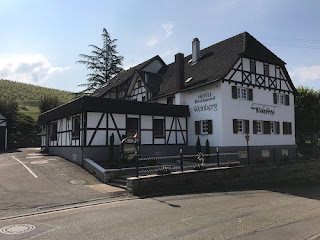


The rest of us were in the dining room, enjoying our dinner, when my mother joined us, reluctantly. “If I wasn’t so hungry, I’d have stayed in the car,” she grumbled. My mom ordered
Kartoffelpuffer, potato pancakes, which she gulped down, enjoying every bite. “It’s just like latkes,” she joked, the food that Jews eat to celebrate the festival of Chanukah.

Many of the well-dressed Germans in the restaurant where we were dining were my mother’s age, old enough to have lived through World War II, or to have fought for the Nazis. She looked at them and said to us, “What were they doing during the war?” Good question. The horrors of World War II and the Holocaust provoke many questions about how a country like Germany that has given the world so much beauty and culture could commit atrocities that took so many millions of lives.


Is it surprising that my mother’s demonizing of Germany made me want to learn more about that country, its language, and its culture? My mother turned Deutschland into a kind of forbidden fruit. She was so intent on teaching me to hate Germany, that I felt I had to make up my own mind about that country.


Some of my first positive experiences with Germany happened when I was in college, studying literature and philosophy. I continually came across references to German culture. I’m a leftist, and so much of the story and of the ideas of the Left come from Germany and Austria. starting with Hegel’s dialectic.
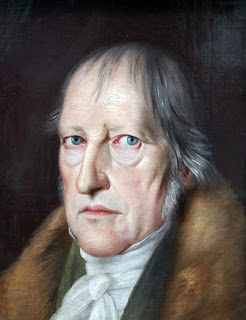

German philosopher Georg W.F. Hegel

Not to mention Marx’s famous statement, “Nicht das Bewußtsein bestimmt das Leben, sondern das Leben bestimmt das Bewußtsein.”—“Consciousness doesn’t determine life; it’s life that determines consciousness.” How true, but how many exceptions there are, too!


Then there was the German philosopher Martin Heidegger’s tantalizing use of the word Dasein, which literally means “existence,” but is made up of the words da, there, and sein, being. In other words, existence is about being there or being present in a certain place and time. How could I understand that elaborate wordplay and its deep resonances without knowing German?


So I began studying German in college. To my surprise, I already knew quite of a few of the words. I had to laugh one day in class when we learned the verb “to drag” in German, which is schleppen. Every Ashkenazi Jew knows what it means to schlep in Yiddish, to drag yourself from one place to another, as in, “Can you believe I had to schlep all the way to Brighton Beach to get a decent knish?”


Likewise, the German word Kinder, children, already meant a great deal to me, because my very Jewish mother would call me and my sister to dinner with the Yiddish word Kinder. It dawned on me that there was a deeper connection between Jews and Germans than my mother had let on. As a friend of mine once put it, “German is a dialect of Yiddish.”


The abrasive tones of the German language still reminded me, though, of those World War II movies where the prisoner of war camp Commandant barked orders in the harshest tones: “Mach schnell!”


One year of college German did not get me to a point where I could really read and speak the language. I had to go to the belly of the beast to develop any fluency. The year my mother died, when I was 20 years old, I traveled to Germany to study in a Goethe-Institut with its intensive German language program where students stay with German families.


I was assigned to a school in a little town in Bavaria called Grafing, almost at the end of a Munich subway line that was newly finished just in time for the Olympics that were to take place that summer of 1972. Grafing turned out to be a strange bubble in time, a village that was like the set of a Richard Wagner opera.
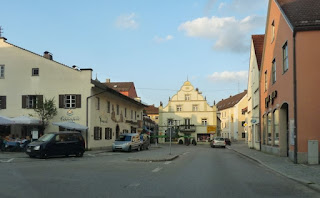

Grafing, Bavaria, Germany
The town had its own brewery that supplied great beer to the locals. Grafing also boasted an amazing bakery strategically located right across the street from the Goethe-Institut. During breaks we ate freshly baked warm Brezeln (pretzels), or Prinzregententorte with its endless layers of chocolate buttercream and sponge cake.

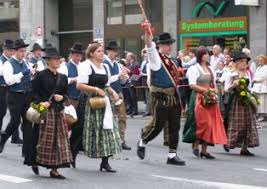
All the students in our program were housed in German homes. Many of the young people from the U.S. reported that they had practically been adopted by their host families. I hardly ever saw mine. The couple I was living with had a newborn who took up all their free time. The American students I spoke to also reported that the families they were staying with made nostalgic comments about how much better things were under Hitler—rural Bavaria was a Nazi stronghold. It didn’t help that, to promote tourism, the Munich city government was encouraging Frauen to wear Dirndls and Männer to wear Lederhosen one day a week, turning the whole city into something out of a third-rate Third Reich propaganda film.


One night a friend from the program and I escaped to the outskirts of our little village and smoked a pipe of hashish that he had scored in the Englischer Garten (the English Garden), headquarters for German hippies in Munich. We were stoned out of our minds when we remembered that one of our teachers at the Goethe-Institut was giving a recital that evening of fairy-tales from the Brothers Grimm. We went back to the school and walked in when the teacher had just begun a story.

Once we settled into our seats, we realized that the instructor was reciting from memory the entire story of Cinderella—Aschenputtel in German. Don’t judge the German language until you’ve heard one of Grimm’s fairy-tales in German. It’s so much more magical than the Disney version. The language is as musical as Beethoven’s Pastoral Symphony—it sweeps you along. In the original version, when the Fairy Godmother creates a dress for Cinderella, Cinderella has to speak a magic spell to a tree, a detail that Disney sadly deleted. Cinderella says,


    “Bäumchen, rüttel dich und schüttel dich, wirf Gold und Silber über mich.”


    Little tree, shake yourself, wake yourself, toss gold and silver over me.


The sounds of that fairytale are so soft, the consonants pillowed by the sibilant “ch” and “s” sounds. The rhymes clink so clearly. And the story is familiar. Not foreign in the least.


Those same qualities that I heard that night in the basement assembly room of a little school in Bavaria I found again when I read in German the gorgeous poetry of Rainer Maria Rilke:


    If only once it would be completely still.

    If that “Almost!” and “Why me?” will

    just this time fall silent—and the laughter

    next door—if my whirring senses didn’t keep after

    me, hobbling me from watching as I ought—


    (translation by Zack Rogow)
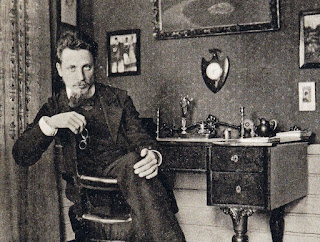

Rainer Maria Rilke

I realized the German I had been fed as a child was only a caricature of that country’s culture, a caricature that admittedly the Germans themselves contributed to making. 

I feel incredibly fortunate that I have lived long enough to see Germany go from one of the worst dictatorships in history and an engine of global intolerance to a lighthouse for democracy and for accepting refugees. I wish my mother could have lived long enough to see today’s Germany. And I also wish Germany’s Jewish citizens could have lived long enough to see it.

_________________________________
Zack’s new book of poetry, The Kama Sutra for Senior Citizens and Other Poems on Aging. Order in the USA    Order in the UK
Other posts of interest:

How to Get Published

Getting the Most from Your Writing Workshop

How Not to Become a Literary Dropout

Putting Together a Book Manuscript

Working with a Writing Mentor

How to Deliver Your Message

Does the Muse Have a Cell Phone?

Why Write Poetry?

Poetic Forms: Introduction, the Sonnet, the Sestina, the Ghazal, the Tanka, the Villanelle

Praise and Lament

How to Be an American Writer

Writers and Collaboration

Types of Closure in Poetry

Saturday, July 22, 2017

The Motown Last Dollar Choice and What It Means for Writers

Not long ago I was fortunate enough to visit the Motown Museum in Detroit, also called Hitsville U.S.A.

The Motown Museum, Detroit

At the end of the guided tour through the museum, I got to stand in Studio A, where a huge number of the greatest songs of the last half century were recorded (photo below).


These songs included hits sung by Michael Jackson, Aretha Franklin, Diana Ross and the Supremes, Stevie Wonder, Martha and the Vandelas, the Temptations, Marvin Gaye…the list goes on and on. So many of these incredibly talented artists were all living in Detroit at the same time in the mid- and late-1960s. That period reminds me of Florence during the Renaissance—Motown Records brought together that sort of concentration of artistic genius all in one place and time.

Our tour guide, Cecilia (the liveliest tour guide ever!),  told us an intriguing story about a decision-making strategy that Motown Records used at its height, a method that I think has important implications for writers. Every Friday morning, the entire Motown community—recording artists, executives, and staff would sit down for a weekly meeting. They would play the tapes of the songs that the singers and musicians had recorded that week and they would ask themselves as a group one key question about that song:

If you were down to your last dollar, would you buy this record or would you buy a sandwich?

If the answer was the record, they would release it. If the answer was the sandwich, it was back to the studio to continue working.

There is something refreshing and honest about this standard. It cuts through a lot of the pretention and gimickry that often plagues the arts.

I wonder how many poets and writers would be willing to subject their work to a similar metric? As a poet, I think there are all-too-many poems that could never in a million years hope to approach that standard. Are there any poems that could reach that bar?

I think there are some poems that are more nourishing to the soul than a sandwich would be to the body. I have my own list (see below), but that list would be different for each person.

I wonder how often we challenge ourselves to write a poem or other work of literature that would reach that bar, and whether we even should? I do think there are poems that contain such an important life lesson, and/or use language in such a beautiful and succinct way, that I would pick them over a pesto chicken panini on an empty stomach.

I think few of us attempt to write in a way that is so universal and compelling because we are distracted by our own stories, our experiments with language, and our own preoccupations. There is also the danger of writing in a way that ends up being corny, or sententious, and those are unpardonable sins in contemporary art. We are so obsessed with authenticity and originality. I think we should be more tolerant of writers who err on the side of being preachy or schmaltzy, because they should be given credit for making the attempt at creating a poem that someone would pick over a sandwich. Academic criticism can be unforgiving of a writer such as Mary Oliver, who can go over the top with her Buddhist life-lesson poems collected in walks in the woods, but I salute her for trying to say something deep and universal, even if she only succeeds some of the time.

Here are the poems that come to my mind as reaching the poem-over-sandwich bar:

William Blake “The Tyger”
Chana Bloch “The Joins”
André Breton “Always for the first time” from The Air of the Water
Robert Desnos “No, Love Is Not Dead”
T.S. Eliot “The Love Song of J. Alfred Prufrock” and “The Hollow Men”
Tess Gallagher “Each Bird Walking”
Federico García Lorca “Sleepwalking Ballad” (or “Somnambule Ballad”) and “Gacela of Unforeseen Love”
Allen Ginsberg “America”
Langston Hughes “Mother to Son”
Frank Paino “Each Bone of the Body”
Edgar Allen Poe “Annabel Lee” and “The Raven”
Kenneth Rexroth, tanka translated in One Hundred Poems from the Japanese
Wislawa Szymborska “True Love”
Walt Whitman, “Song of Myself”
Yosano Akiko, various tanka from Midaregami, including “tell me this evening as you gaze eastward…,” “my hands cover my breasts…,” “early evening moon rising over a field of flowers…”


Zack’s most recent book of poems, Irreverent Litanies
Zack’s most recent translation, Bérénice 1934–44: An Actress in Occupied Paris by Isabelle Stibbe

How to Get Published

Getting the Most from Your Writing Workshop
How Not to Become a Literary Dropout
Putting Together a Book Manuscript
Working with a Writing Mentor
How to Deliver Your Message
Does the Muse Have a Cell Phone?
Why Write Poetry? 
Poetic Forms: IntroductionThe SonnetThe SestinaThe GhazalThe TankaThe Villanelle
Praise and Lament
How to Be an American Writer
Writers and Collaboration
Types of Closure in Poetry

Thursday, July 24, 2014

Writers’ Career Paths, Part 2: Peaking at the Beginning, Middle, or End?

The writer Joseph Heller published his first novel Catch-22 in 1961 at the age of 38. He went on to publish six more novels, as well as plays, screenplays, and two autobiographies. I’ve only read some of his later books, and Good as Gold was memorable, but I don’t think many readers would dispute that his first book was his best.

Joseph Heller with his family, not long after the publication of Catch-22
I knew Joseph Heller a little bit growing up. His daughter Erica and I were classmates and friends in our early teens. Joseph Heller was as funny as his books. Tall, broad-shouldered, he towered over most people. He used to describe himself as “The World’s Tallest Midget.” But I digress.

Publishing his best book first put Joseph Heller in excellent company. There was also Charlotte Brontë, who wrote Jane Eyre at age of 31 before any of her other novels. J.D. Salinger authored many good books, but I think the consensus is that his first book, The Catcher in the Rye, is the classic of all his works.

Why would a writer create her or his best book right at the beginning of a career, before that person has the experience, maturity, and craft to polish a work to a shining finish? Sometimes the first great plot or narrator’s voice that gets a writer on the page is so good, it just can’t be outdone. Many writers who write their best book first keep trying to recreate that magic, but hey!—writing one great book is nothing to sneeze at. How many have done it?

More common as a trajectory for writers is to produce the best books in mid-career. One great example of this is Virginia Woolf. She published her first book, The Voyage Out, in 1915 at the age of 33. In my opinion, Virginia Woolf never wrote a bad book, but she certainly hit her stride in the middle of her career, when she published in succession Mrs. Dalloway (1925), To the Lighthouse (1927), Orlando, (1928), and A Room of One’s Own (1929). That has to be one of the best four-year runs in the history of literature. Her subsequent novels were also good, but, to my mind, not up to that amazing mid-career burst.

There are many other examples of writers who warm up with a few books of fair to middling quality, then write their masterpiece(s), and finish a career with works that don’t quite measure up. In his early years Leo Tolstoy wrote three autobiographical novels that are rarely read. Those were the prelude to War and Peace and Anna Karenina, which he penned in middle age, but didn’t equal again in his later years, despite his fame. 

It makes sense that peaking in mid-career is the most common path—at that stage, the writer has acquired some chops, and has begun to discover which themes are closest to their heart. Energy and originality are still relatively easy to access.

Another familiar example of this trajectory is Gustave Flaubert, who wrote Madame Bovary in mid-career. But the author Dorothy Bryant argues in her play Dear Master based on the correspondence of Flaubert and George Sand that all his previous work led up to the exquisite novella “A Simple Heart,” which he wrote toward the end of his life.

Dorothy Bryant
That leads us to the third type of author, one who is striving to write a certain kind of book all their life and realizes that ambition after many false starts, only at the end of a career. The poet Rainer Maria Rilke authored books of poetry starting in his adolescence, but one could argue that his greatest period was a stretch of only a few weeks in February 1922, four years before his death, when two of his most celebrated books poured out of him, almost as if dictated: Duino Elegies and Sonnets to Orpheus. At least, that is the legend that Rilke promoted, which was good business, since it gave those two later books a special status.

George Orwell wrote excellent nonfiction from the start of his career, but only his devoted fans (like me!) read his early fiction. Right at the end of his life, though, he wrote both Animal Farm and 1984, by far his two most famous and widely read works.


One can also see the rationale behind the career that climaxes in a best book or books. It can take a whole lifetime to get it right, to assemble the toolbox that a writer needs to build the dream house, the work that brings together the themes that eluded the author at a less mature stage. That older author then has all the craft it takes to realize the potential of the blueprint.

_______________________

Zack Rogow’s book of translations, The Water Drinkers and Other Sketches of Paris in the Romantic Era, from the French of Henry Murger

Other recent posts about writing topics: 
How to Get Published
Getting the Most from Your Writing Workshop
How Not to Become a Literary Dropout
Putting Together a Book Manuscript
Working with a Writing Mentor
How to Deliver Your Message
Does the Muse Have a Cell Phone?
Why Write Poetry? 
Poetic Forms: IntroductionThe SonnetThe SestinaThe GhazalThe Tanka
How to Be an American Writer

Friday, December 14, 2012

Why Write Poetry: Part 4, Spoken Music

We speak music. We’re not always aware of the sounds of our words, but speech is constantly morphing into music. Rhymes pop up in everyday banter, meters appear in unlikely phrases. Poetry just makes those natural patterns more evident, more closely bonded to meaning.
Unlike prose, poetry is essentially a spoken art. Fiction and nonfiction can be read out loud, but poetry is meant to be read to live human beings. Poetry is composed to create the music of phonemes.
Some of the poets I admire the most are the ones who can make words into music, without gilding the lily. Why do so many people commit their favorite poems to memory? There is a power in the rhythms of words when they are activated by syntax and meaning.
One of the first times I really fell in love with poetry was when I was attending the Bronx High School of Science (not the most likely venue for poetry!). My sophomore-year French teacher, Janice Gerton, who is now in her 90s and remains an active fan of literature, recited to the class a poem she had memorized by the poet Paul Verlaine (1844–1896). The poem begins like this:

Il pleure dans mon coeur
Comme il pleut sur la ville ;
Quelle est cette langueur
Qui pénètre mon coeur ?

Loosely translated, it sounds like this in English:

Tears fall through my heart
Like rain tears through this city;
What’s this anguish like a dart
That lands in my heart?

(translation © 2012 by Zack Rogow)

Verlaine’s poem (I’ve only quoted one stanza) is so haunting because the sounds of the words recreate the murmur of the rainfall that is filling up the city. The repetitions are oddly soothing, given that it’s a poem about deep and incomprehensible sadness. Somehow, hearing or saying a poem this musical allows us both to feel our own sorrow more deeply, and to begin to heal from it. A poem such as Verlaine’s is like a magic spell, where the words create an actual physical effect in the world.

 I have a personal list of poems I particularly enjoy where the music is extremely effective for me. Here are some of my favorites, in no special order:

Edgar Allan Poe, "Annabel Lee," “The Bells,” “The Raven”  
Faiz Ahmed Faiz, “There’s No Messiah for a Broken Mirror” (in Urdu)
Sahir Ludhyanvi, “Your Voice,” “Taj Mahal” (also in Urdu)
Charles Baudelaire, “Correspondances,” “Invitation au Voyage"
Arthur Rimbaud, “Le Bateau Ivre”
Shakespeare’s sonnets, especially XVIII, XXIX, XXX, LV, CXVI, CXXX
Ezra Pound’s version of "The Seafarer" translated from Anglo-Saxon
Gerard Manley Hopkins, “God’s Grandeur” (read here by Stanley Kunitz), “Pied Beauty”
Geoffrey Chaucer’s Canterbury Tales, opening lines
June Jordan, “On Your Love,” “On a New Year’s Day,” “Roman Poem #14”
Ntozake Shange, “Orange butterflies aqua sequins…” (at 6:00 into the video), “Somebody almost made off wid all my stuff”
Sekou Sundiata, “Space,” “Blink Your Eyes”
Antonio Carlos Jobim, “Waters of March” (Águas de Março,” sung here by the immortal Elis Regina)

Those are poems that I love to recite or sing or hear read over and over, just to experience how it feels to say those words, and how they sound out loud.

Other recent posts about writing topics:
Why Write Poetry? Part 1Part 2Part 3Part 4

How to Get Published
Getting the Most from Your Writing Workshop
How Not to Become a Literary Dropout
Putting Together a Book Manuscript
Working with a Writing Mentor
How to Deliver Your Message
Does the Muse Have a Cell Phone?
Poetic Forms: IntroductionThe SonnetThe SestinaThe GhazalThe Tanka

Praise and Lament
How to Be an American Writer

Friday, November 9, 2012

Rilke's "Autumn Day"

The poet Rainer Maria Rilke uses language in uniquely powerful ways in his moving poem, “Autumn Day” (“Herbsttag”). The poem appears in the first section of Rilke’s collection The Book of Pictures, published 1902.

                                              Rainer Maria Rilke (1875–1926)

Here’s my own English translation:

Autumn Day

by Rainer Maria Rilke

Time, Lord, it’s time. The summer was vast.
Now drape your shadow over sundials,
And in the fields, make the winds blast.

Command the last fruits to brim on the vine;
Give them two more southerly days,
Push them to perfection and blaze
The last sweetness into the heavy wine.

Whoever has no house yet, will build none.
Whoever is alone, will stay alone,
Wake up at night, write long letters, sift
Through pages, and walk up and down
Tree-lined paths, restless, while leaves drift.

            (translated by Zack Rogow, translation © 2012 by Zack Rogow)

What a fascinating structure Rilke has created for this poem! He substitutes for the stanza of regular length his own distinctive formula where each successive stanza acquires one more line, as if every stanza digs to a deeper layer of fall and the emotions connected to it.

The first two stanzas create a sense of fulfillment. This aura is still partly abstract in the first stanza, beautiful, but limited to disembodied shadows and winds. In the second stanza he adds color, taste, and smell to the richness of fall by expanding to the sensual realms of fruit, warmth, and wine.

Now look at Rilke’s German:

Herbsttag

Herr: es ist Zeit. Der Sommer war sehr groß.
Leg deinen Schatten auf die Sonnenuhren,
und auf den Fluren laß die Winde los.

Befiehl den letzten Früchten voll zu sein;
gieb ihnen noch zwei südlichere Tage,
dränge sie zur Vollendung hin und jage
die letzte Süße in den schweren Wein.

Wer jetzt kein Haus hat, baut sich keines mehr.
Wer jetzt allein ist, wird es lange bleiben,
wird wachen, lesen, lange Briefe schreiben
und wird in den Alleen hin und her
unruhig wandern, wenn die Blätter treiben.

[emphases added]

Rilke highlights the feeling of fulfillment in the first two stanzas by using the German word voll—full—in two different forms, the adjective, voll, and the noun, Vollendung, which means completion, finishing, ending, consummation, perfection. Not only that, Rilke takes the wide-open vowel o from the German word for full, and lavishes it over the first stanza: groß, Sonnenuhren, los, emphasizing the sound by using it in rhyming words that end lines one and three. I’ve highlighed in blue each word in the poem that contains the letter ‘o’ in the German.

The sentences in the poem start out very short and then get increasingly long in the first two stanzas, as the imagery become more lush and hypnotic, while the picture of fall’s completion develops—“Now drape your shadows over sundials,” “Command the last fruits to brim on the vine.”

Suddenly, in stanza three, we are back to short, declarative language: “Whoever has no house yet, will build none.” The words have the authority and stateliness of a biblical judgment, or of a proverb. The second line in the last stanza seems like it’s about to mirror this structure with another matter-of-fact, symmetrical pronouncement: “Whoever is alone, will stay alone,” but then surprisingly the sentence continues, sweeps us along until the very end of the poem, taking us into the very private world of the solitary person whose autumn is not one of fullness but of emptiness and loneliness.

Take another look at the German. Amazingly, Rilke is able to write the entire last stanza without once using the vowel o, the vowel in the German word for ‘full’ that saturates the first two stanzas, where it continually evokes the sense of fullness. There are few other poets who would use sound in such a methodical, unique, and strange way, foreshadowing the lipogrammatic experiments of OULIPO group members such as Georges Perec, who wrote his entire novel A Void without the letter e.

There is a powerful sense of nostalgia and melancholy in Rilke’s poem, but in two different shades: in the first two stanzas we have yellow-orange sunlight and the long shadows of fall afternoons, colors of ripe fruit and the final warm days; in the last stanza there are the bare trees and the nocturnal scene of the lone man, a colorless world where nothing seems anchored or still.

What kind of person is the figure in the last stanza who wakes up late at night, reads, and writes long letters? An artist, specifically a writer. We know Rilke lived this kind of restless existence, moving from city to city and country to country every few months during many periods of his life. Perhaps he is talking about entering a stage in his life when he will banish himself from the warmth of a family home, destined to a solitary pursuit of literature and his correspondence with friends. This was, to some extent, the plot of Rilke’s life, which he might have seen taking shape at the juncture when he wrote “Autumn Day.” It’s so paradoxical that the poet has the otherworldly power to order God to begin the change of season to the fall (“drape,” “Command,” “push,” etc.), but he ends up alone and isolated at the end, despite that force (or because of it?).

Rilke was involved for several years with Lou Andreas-Salomé, a brilliant woman of letters who had been romantically connected to the philosopher Friedrich Nietzsche when she was a young woman. 

Lou Andreas-Salomé
                                  
There were thoughts Rilke confided only to Lou, and, as a practicing therapist who herself had been analyzed by Sigmund Freud, she understood the poet Rilke better than many. She discusses Rilke’s Duino Elegies in her autobiography, Looking Back: Memoirs: “…one sees clearly, and with a shudder of certainty, how greatly Rainer longed for human experience, for the revelation of life, which, in spite of the perfection of his achievement, would go beyond the work of art, beyond the poet’s word. Only there could that which was most deeply human in Rainer find a resting place, and peace.…Nothing is more certain than that Rainer achieved the joyous affirmation of his own despair in the celebration of the Elegies.” I find this comment about Rilke revealing. Maybe “Autumn Day” is, like Rilke’s Duino Elegies, both a celebration of the poet’s own despair, and his expression of longing for human warmth. That conflict is part of why "Autumn Day" continues to fascinate readers and to endure.


Other posts on Rilke:
Learning from Rilke
Rilke's "Archaic Torso of Apollo"

Other recent posts about writing topics: 

How to Get Published
Getting the Most from Your Writing Workshop
How Not to Become a Literary Dropout
Putting Together a Book Manuscript
Working with a Writing Mentor
How to Deliver Your Message
Does the Muse Have a Cell Phone?
Why Write Poetry? 
Poetic Forms: IntroductionThe SonnetThe SestinaThe GhazalThe Tanka

Praise and Lament
How to Be an American Writer